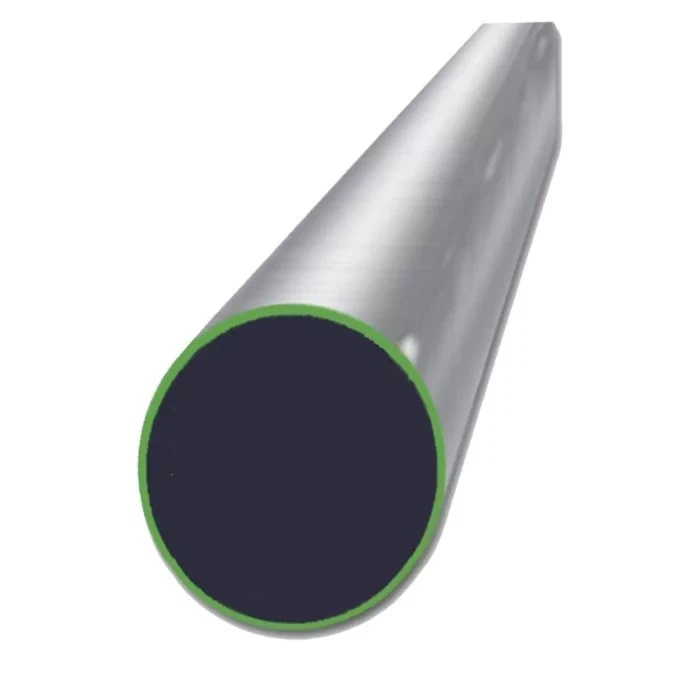
What is Stainless Steel 310S?
 310S (UNS S31008) is an austenitic stainless steel of the "25/20" family - about 25% chromium and 20% nickel. The high chromium-nickel balance gives it excellent high-temperature strength and outstanding resistance to oxidation, scaling, carburization and sulfidation. The "S" denotes the low-carbon version of grade 310 (carbon ≤0.08% vs ≤0.25% for 310), which makes 310S the preferred, weld-friendly grade for fabricated high-temperature equipment. It is non-magnetic in the annealed condition and retains good toughness even at cryogenic temperatures.
About 310S Stainless Steel Pipe
Chemical composition (ASTM A312 TP310S)
|
Element |
310S (S31008), % max unless noted |
|
Carbon (C) |
≤ 0.08 |
|
Manganese (Mn) |
≤ 2.00 |
|
Phosphorus (P) |
≤ 0.045 |
|
Sulfur (S) |
≤ 0.030 |
|
Silicon (Si) |
≤ 1.00 |
|
Chromium (Cr) |
24.00 – 26.00 |
|
Nickel (Ni) |
19.00 – 22.00 |
|
Molybdenum (Mo) |
≤ 0.75 |
|
Iron (Fe) |
Balance |
Mechanical properties
|
Property |
310S (S31008) |
|
Tensile strength |
≥ 515 MPa (75 ksi) |
|
Yield strength (0.2% offset) |
≥ 205 MPa (30 ksi) |
|
Elongation (in 50 mm) |
≥ 40% |
|
Hardness, Brinell (max) |
≤ 217 HB |
|
Hardness, Rockwell B (max) |
≤ 95 HRB |
Physical properties
|
Property |
Value |
|
Density |
8.0 g/cm³ (0.289 lb/in³) |
|
Melting point |
≈ 1454–1455 °C (2650 °F) |
|
Modulus of elasticity |
≈ 200 GPa (29 × 10⁶ psi) |
|
Thermal conductivity (≈ room temp) |
≈ 14.2 W/m·K |
|
Coefficient of thermal expansion |
≈ 15.5 × 10⁻⁶ /K (typical) |
|
Magnetic? |
No (annealed); slightly magnetic after cold work |
Equivalent grades
|
Standard |
Designation |
|
UNS |
S31008 |
|
EN / DIN (Werkstoff) |
1.4845 |
|
EN name |
X8CrNi25-21 |
|
JIS |
SUS 310S |
|
BS (old) |
310S16 |
|
GOST |
20Ch23N18 (20Х23Н18) |
|
AFNOR |
Z8CN25-21 |
Standards & specifications
|
Product form |
ASTM / ASME standard |
|
Seamless & welded pipe |
ASTM A312 / ASME SA312 (TP310S) |
|
Seamless tube |
ASTM A213 (TP310S) |
|
Welded tube |
ASTM A249 (TP310S) |
|
Welded & sanitary tube |
ASTM A269 / A270 |
|
Electric-fusion-welded (EFW) pipe |
ASTM A358 (TP310S, Class I–V) |
|
Plate, sheet, strip |
ASTM A240 / ASME SA240 (310S) |
|
Forged flanges & fittings |
ASTM A182 (F310S) |
|
Welded fittings |
ASTM A403 (WP310S) |
|
Bar & rod |
ASTM A276 / A479 |
Available sizes & dimensions
Seamless pipe: 1/2" – 18" NB (up to 48" NB on request).
Welded / ERW pipe: 1/2" – 16" NB.
EFW pipe: 8" – 110"+ NB.
Wall thickness: SCH 5, SCH10, SCH 40, SCH 80, SCH 80S, SCH 160, SCH XXS, SCH XS.
Length: up to 12 m, cut-to-length and random lengths available.
Types: Welded, Seamless, EFW, Fabricated, ERW.
Finishes: 2B, BA, No.4, No.1, No.8 Mirror Finish or custom.
High-temperature performance
|
Condition |
Maximum service temperature |
|
Continuous service (oxidation) |
up to ≈ 1150 °C (2100 °F) |
|
Intermittent service |
up to ≈ 1040 °C (1900 °F) |
|
Typical operating start point |
≈ 800–900 °C and above |

Corrosion resistance
Excellent resistance to oxidation, scaling, carburization and sulfidation at elevated temperature.
Good aqueous corrosion resistance in non-chloride media thanks to high chromium.
Resists sulfur dioxide and other hot gases; widely used where SO₂ is encountered.
PREN ≈ 25 (similar to 316L) - but it is NOT a seawater/marine grade and is susceptible to chloride pitting and stress-corrosion cracking like other austenitics.
Weldability & fabrication
310S welds readily by common processes (GTAW, GMAW, SMAW, SAW), with weldability comparable to 304/304L. Use matched filler metal such as ER310 / E310, or ER309 for dissimilar joints. Because 310S has a higher coefficient of thermal expansion than 304, control heat input and fixturing to minimize distortion and warping. Severe cold forming should be followed by annealing.
310S Stainless Steel Pipe Manufacturing Process
Raw Material Inspection → Cutting → Piercing / Forming → Hot Rolling or Cold Drawing → Heat Treatment → Pickling → Straightening → Cutting → Dimensional Inspection → PMI Testing → Hydrostatic Testing → Marking → Packaging

Typical Applications
Furnace & Heat Treatment: Furnace tubes, radiant tubes, furnace chambers, retorts, annealing equipment
Petrochemical Industry: Cracking furnace tubes, process heaters, high-temperature piping, refinery equipment
Power Generation: Boiler components, superheater components, thermowells, gas turbine components
Waste Incineration: Incinerator tubes, combustion chambers, high-temperature exhaust systems

Quality Inspection And Inspection Documents
| Quality Inspection | Inspection Documents |
| PMI / Positive Material Identification | EN 10204 3.1 Certificate |
| Chemical Composition Testing | Mill Test Certificate |
| Tensile Testing | PMI Report |
| Yield Strength Testing | Hydrostatic Test Report |
| Elongation Testing | Dimensional Inspection Report |
| Hardness Testing | NDT Report |
| Hydrostatic Testing | |
| Eddy Current Testing | |
| Ultrasonic Testing | |
| Dimensional Inspection | |
| Visual Inspection | |
| Surface Inspection |


310S vs 304 vs 316L vs 309S-what is the difference?
| Property | 304 | 316L | 309S | 310S |
|---|---|---|---|---|
| Cr | ~18–20% | ~16–18% | ~22–24% | ~24–26% |
| Ni | ~8–11% | ~10–14% | ~12–15% | ~19–22% |
| High-temperature resistance | Medium | Medium | High | Very High |
| Oxidation resistance | Good | Good | Excellent | Excellent |
| Chloride resistance | Good | Better | Moderate | Moderate |
| Typical use | General industry | Chemical / marine | High-temperature | Furnace / heat treatment |
FAQ
What is Stainless Steel 310S pipe used for?
310S pipe is used wherever sustained high temperature and oxidation/carburization resistance are required: furnaces, radiant tubes, heat exchangers, burners, kilns, incinerators, petrochemical heaters and refining/cracking units. It is a high-heat grade, not a marine grade.
What temperature can 310S stainless steel withstand?
Up to about 1150 °C (2100 °F) in continuous oxidation service and about 1040 °C (1900 °F) in intermittent service. It generally performs from roughly 800–900 °C upward, outperforming 304 and 309.
What is the difference between 310 and 310S?
310S is the low-carbon version of 310 (≤0.08% vs ≤0.25% C). The lower carbon avoids sensitization and intergranular corrosion after welding, making 310S the standard for welded fabrications, while higher-carbon 310 has slightly stronger creep resistance for high-stress high-temperature parts.
Is 310S stainless steel good for seawater or marine use?
No. 310S is optimized for high-temperature oxidation and carburization, not chloride resistance. It is susceptible to pitting and chloride stress-corrosion cracking like other austenitics. For seawater/marine service use 316L at minimum, and super duplex 2507 or 6Mo 254 SMO for continuous seawater.
Which ASTM standards cover 310S pipe?
Pipe: ASTM A312 / ASME SA312 (TP310S); EFW pipe ASTM A358; tube ASTM A213/A249/A269; plate ASTM A240; forged flanges/fittings ASTM A182 F310S; welded fittings ASTM A403 WP310S. (ASTM A789/A790 do NOT apply - those are duplex-only.)
What filler metal is used to weld 310S?
Matched filler such as ER310 / E310 is typical; ER309 is often used for dissimilar joints. Control heat input because of 310S's higher thermal expansion, and anneal after severe forming.
Related Products
Stainless Steel 304 Seamless Pipes
316L Stainless Steel Pipe
2205 Duplex Stainless Steel Pipe
S31254 254SMO Stainless Steel Pipe
Hot Tags: 310s stainless steel pipe, China 310s stainless steel pipe manufacturers, suppliers, factory