


Hey there! As a carbon steel plate supplier, I often get asked about the weight calculation formula for carbon steel plates. It's a pretty common question, and it's actually not that complicated once you get the hang of it. In this blog post, I'm going to break down the formula, explain why it's important, and give you some real - world examples.
First things first, let's talk about why knowing the weight of a carbon steel plate matters. Whether you're a construction company building a skyscraper, a manufacturer making machinery, or just someone doing a DIY project at home, understanding the weight is crucial. It helps with transportation planning, load - bearing calculations, and cost estimation. After all, the heavier the plate, the more it might cost to ship, and you need to make sure your structure can handle the load.
So, what's the formula? The basic formula for calculating the weight of a carbon steel plate is:
Weight (kg) = Length (m) × Width (m) × Thickness (mm) × Density (g/cm³) ÷ 1000
Let's break this down step by step.
Length and Width
The length and width are pretty straightforward. You measure them in meters. If you're working with imperial units, you'll need to convert them to meters first. For example, if you have a plate that's 6 feet long and 3 feet wide, you'd convert those measurements. Since 1 foot is approximately 0.3048 meters, a 6 - foot length is 6 × 0.3048 = 1.8288 meters, and a 3 - foot width is 3 × 0.3048 = 0.9144 meters.
Thickness
The thickness is measured in millimeters. This is important because the density of carbon steel is usually given in grams per cubic centimeter, and using millimeters for thickness makes the calculation work out nicely. Say you have a plate that's 10 millimeters thick.

Density
The density of carbon steel typically ranges from about 7.85 g/cm³. This is an average value, and it can vary slightly depending on the specific type of carbon steel. For most common carbon steel plates, using 7.85 g/cm³ will give you a pretty accurate result.
The Calculation
Let's use an example. Suppose we have a carbon steel plate that's 2 meters long, 1 meter wide, and 15 millimeters thick.
First, we plug the values into the formula:
Weight (kg) = 2 (m) × 1 (m) × 15 (mm) × 7.85 (g/cm³) ÷ 1000
2 × 1 = 2
2 × 15 = 30
30 × 7.85 = 235.5
235.5 ÷ 1000 = 0.2355 tons or 235.5 kg
Now, let's talk about different types of carbon steel plates. We offer a variety of options, like Q235 Carbon Steel Plate. Q235 is a widely used carbon steel. It has good plasticity, toughness, and weldability. When calculating the weight of a Q235 carbon steel plate, you'd use the same formula as above.
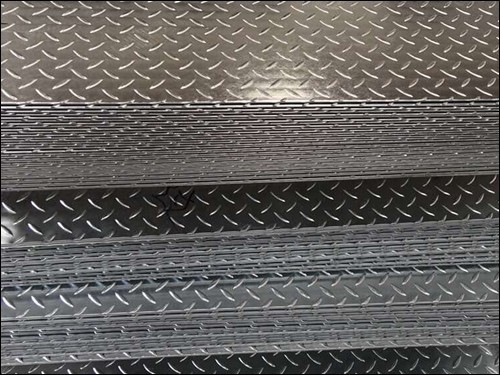
Another type is Carbon Steel Tread Plate. Tread plates are used for applications where slip - resistance is important, like stairways and walkways. The weight calculation for these plates also follows the same formula.
We also have A516 ASTM Carbon Steel Plate. A516 is often used in pressure vessels because of its good notch toughness. Again, the weight calculation formula remains the same.
It's important to note that sometimes, the actual weight of a carbon steel plate might deviate slightly from the calculated weight. This can be due to manufacturing tolerances. For example, the actual thickness of the plate might be a bit different from the specified thickness. But in most cases, the calculated weight gives you a good estimate.
If you're in the market for carbon steel plates, it's a good idea to know the weight in advance. It can help you compare prices from different suppliers. A heavier plate might cost more, but it could also be more suitable for your application.
When you're calculating the weight for a large order of carbon steel plates, you can use a spreadsheet to make things easier. Just enter the length, width, thickness of each plate, and let the spreadsheet do the math for you. This way, you can quickly add up the weights of all the plates in your order.
In conclusion, the weight calculation formula for carbon steel plates is a useful tool for anyone dealing with these materials. Whether you're a professional in the industry or a DIY enthusiast, it helps you make informed decisions.
If you're interested in purchasing carbon steel plates, we're here to help. We have a wide range of sizes, thicknesses, and types available. Just reach out to us, and we can discuss your specific needs and provide you with a quote.
References
- ASM Handbook Volume 1: Properties and Selection: Irons, Steels, and High - Performance Alloys
- Metals Handbook Desk Edition, 3rd Edition


