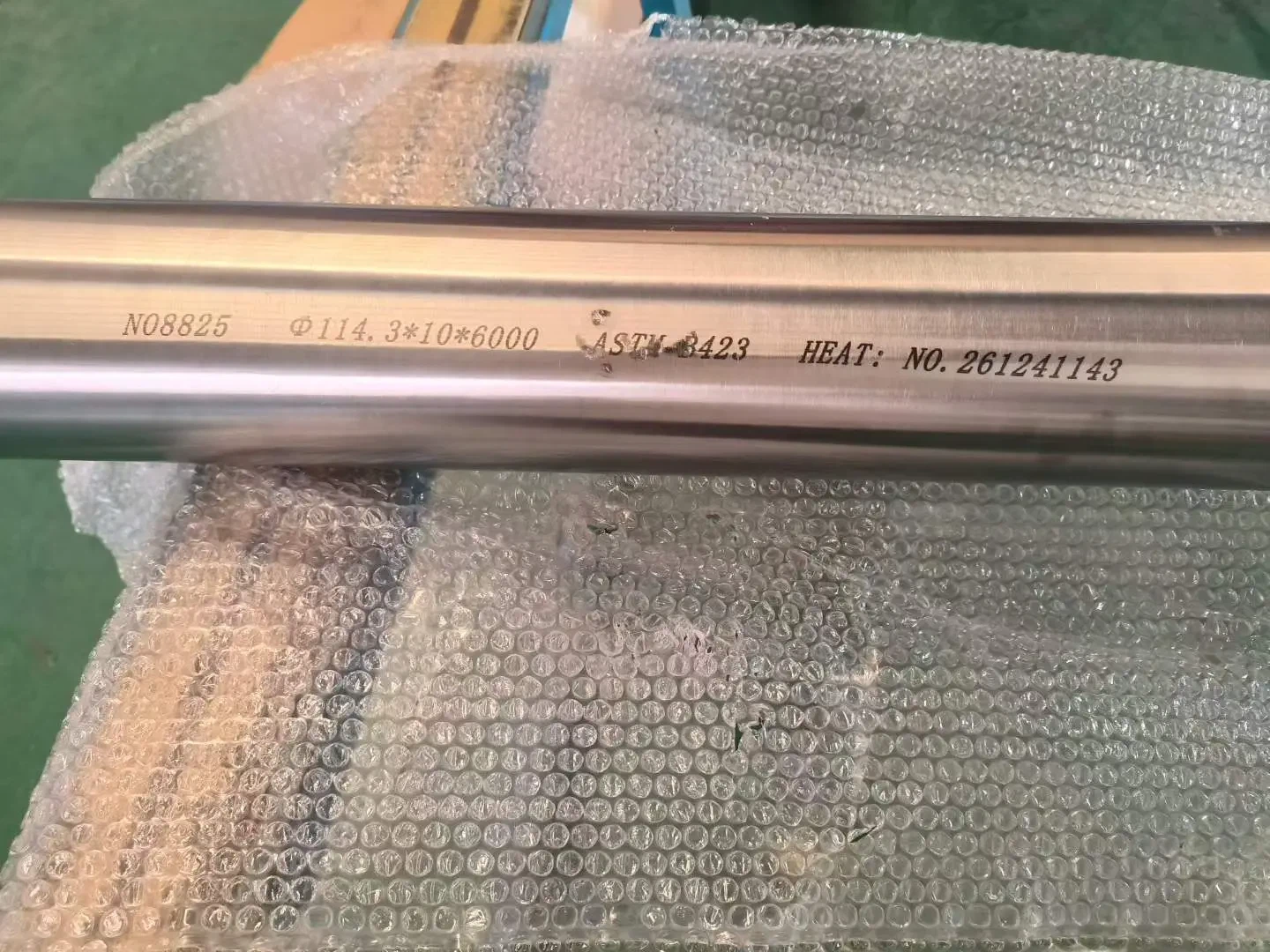
I. Alloy Nature and Composition Design: A Precisely Formulated "Synergistic Corrosion-Resistant System"
Incoloy 825 is not a pure nickel-based alloy; rather, it is a multi-component, stabilized austenitic alloy featuring an iron-based matrix supplemented by a core nickel framework. Its globally unified digital designation is UNS N08825, corresponding to the German standard 2.4858 and the Chinese national standard 0Cr21Ni42Mo3Cu2Ti. The design of its chemical composition revolves entirely around three core objectives: "dual resistance to both oxidizing and reducing environments," "resistance to chloride ion corrosion," and "weld stabilization." The core compositional ranges and the specific functions of the constituent elements, as stipulated by the ASTM B423 standard, are outlined below:
Element | Standard Mass Fraction Range | Core Functional Role
Nickel (Ni) | 38.0%–46.0% | Forms the core matrix of the alloy; stabilizes the austenitic microstructure; serves as the fundamental basis for resistance against reducing media and Chloride Stress Corrosion Cracking (SCC), thereby completely resolving issues of cracking failure in stainless steels within chloride-rich environments.
Chromium (Cr) | 19.5%–23.5% | Forms a dense Cr₂O₃ passivation film on the alloy surface; provides excellent oxidation resistance and corrosion resistance against oxidizing acids (such as nitric acid and concentrated sulfuric acid); and works synergistically with Molybdenum to enhance resistance against pitting and crevice corrosion.
Molybdenum (Mo) | 2.5%–3.5% | Significantly enhances the alloy's corrosion resistance in reducing acidic media, such as dilute sulfuric acid and phosphoric acid; serves as a key element for improving resistance against chloride-induced pitting and crevice corrosion; and optimizes the retention of mechanical strength at medium to high temperatures.
Copper (Cu) | 1.5%–3.0% | Specifically enhances the alloy's corrosion resistance in reducing environments, such as those involving sulfuric acid and organic acids; creates a synergistic effect with Molybdenum; and is the critical factor enabling this alloy's suitability for applications in chemical pickling and hydrometallurgy.
Iron (Fe) | ≥22.0% (Balance) | A supplementary element for the alloy matrix; significantly reduces raw material costs without substantially compromising performance-a core reason for its cost-effectiveness advantage compared to pure nickel-based alloys.
Titanium (Ti) | 0.6%–1.2% | A stabilizing element that fixes carbon within the alloy structure; inhibits intergranular sensitization during welding processes; ensures the retention of excellent resistance to intergranular corrosion after welding; and makes the alloy highly suitable for on-site welding and construction applications.
Carbon (C) | ≤0.05% | Features an ultra-low carbon design that minimizes the risk of intergranular carbide precipitation; enhances the alloy's resistance to intergranular corrosion and improves its welding stability at the fundamental level.
II. Core Performance Advantages: The Core Competence for Adapting to Harsh Operating Conditions
1. Comprehensive Corrosion Resistance Across All Dimensions
This constitutes the most fundamental advantage of Incoloy 825, achieving full-spectrum corrosion resistance coverage across "oxidizing media + reducing media + complex chloride-containing media." It is also the primary reason why it serves as a superior substitute for stainless steel:
Resistance to Reducing Acid Corrosion: It demonstrates exceptional performance across a wide range of concentrations in sulfuric acid, phosphoric acid, and organic acids. It can withstand boiling sulfuric acid concentrations of up to 60%, offering a service life more than five times longer than that of 316L stainless steel.
Resistance to Chloride Ion Corrosion: Its high nickel content endows it with exceptional immunity to chloride-induced stress corrosion cracking. Certified under the NACE MR0175 standard for sour oil and gas environments, it can withstand seawater and brine environments with chloride ion concentrations reaching 50,000 ppm, thereby completely resolving the "cracking pain point" inherent in stainless steel.
Resistance to Intergranular Corrosion: Featuring a combination of titanium stabilization and an ultra-low carbon design, it maintains stable resistance to intergranular corrosion even after prolonged exposure to welding sensitization temperature ranges, eliminating the need for post-weld heat treatment.
Resistance to Sulfide Corrosion: It is ideally suited for acidic oil and gas fields containing H₂S and CO₂, as well as petrochemical refining applications; it stands as the global standard piping material for sour oil and gas extraction operations. 2. Stable Mechanical and Processing Properties
The standard delivery condition for Incoloy 825 seamless tubes is solution annealing (held at 920–980°C followed by rapid cooling). In this state, the core mechanical properties fully satisfy the requirements for industrial pressure-bearing pipelines:
Room-temperature Tensile Strength: ≥ 517 MPa (typical range: 590–725 MPa);
Room-temperature Yield Strength: ≥ 172 MPa (typical range: 240–300 MPa);
Elongation at Break: ≥ 30%, demonstrating excellent toughness and impact resistance;
Maximum Long-term Service Temperature: ≤ 540°C. While capable of withstanding high temperatures of up to 800°C for short durations, it retains 70% of its tensile strength at 540°C-a figure far exceeding the 425°C service limit of ordinary carbon steel.
Furthermore, this alloy can be formed using traditional cold or hot working methods. It is compatible with standard welding processes such as Tungsten Inert Gas (TIG) and Metal Inert Gas (MIG) welding; the use of ERNiCrMo-3 filler metal is recommended. The material requires neither complex pre-weld preheating nor post-weld heat treatment, thereby significantly reducing the difficulty of on-site construction.
3. Unrivaled Cost-Effectiveness
Within the realm of high-end corrosion-resistant alloys, Incoloy 825 occupies a remarkably precise market position:
In terms of Performance: Its resistance to both corrosion and high temperatures comprehensively outperforms high-end stainless steels such as 316L and 317L, enabling it to address severe operating conditions where stainless steels are unsuitable.
In terms of Cost: Compared to pure nickel-based alloys-such as Inconel 625 and Hastelloy C276-its raw material costs are 30% to 50% lower. Moreover, its lower processing and welding complexity translate into significant advantages regarding total lifecycle costs.
These attributes have established Incoloy 825 as the "preferred general-purpose corrosion-resistant alloy tubing" for industrial projects worldwide. Its demand growth continues to lead the market-particularly in cost-sensitive emerging economies such as India and Southeast Asia.
III. International Standards and Specifications: Core Guidelines for Foreign Trade Procurement and Production
The global trade and application of Incoloy 825 seamless tubes strictly adhere to a unified system of international standards. The core standards and specifications-outlined below-serve as the fundamental basis for foreign trade procurement, contract negotiation, and quality acceptance:
1. Core Applicable Standards
ASTM B423 / ASME SB423: The globally recognized, dedicated standard specifically for Incoloy 825 seamless tubes. It stipulates comprehensive technical requirements-including chemical composition, dimensional tolerances, mechanical properties, inspection criteria, and delivery conditions-and constitutes a mandatory core standard that must be explicitly specified in foreign trade contracts.
ASTM B829: The general technical requirements standard for nickel-based alloy seamless tubes. Serving as a supplement to ASTM B423, it establishes general specifications regarding manufacturing processes, heat treatment, non-destructive testing, and other related procedures for seamless tubes.
Other Supporting Standards: ASTM B424 for plates/sheets, ASTM B425 for bars/rods, ASTM B366 for pipe fittings, and ASTM B705 for welded tubes; these standards collectively cover the full spectrum of product forms. 2. International Equivalent Grades (Globally Interchangeable in Trade)
Table
Country / Region | Standard System | Equivalent Grade
USA | ASTM/ASME | UNS N08825, Incoloy 825
Germany / EU | EN/DIN | 2.4858
Japan | JIS | NCF825
China | GB/T | 0Cr21Ni42Mo3Cu2Ti, NS1403
3. Mandatory Inspection and Delivery Requirements
In international procurement, in addition to specifying standards and grades, the following core requirements must be clearly defined to avoid risks during acceptance inspection and customs clearance:
Delivery Condition: Must be in the solution-annealed + pickled and passivated / bright-annealed state; delivery in a non-heat-treated state is strictly prohibited.
Non-Destructive Testing (NDT): Every tube must undergo Ultrasonic Testing (UT), Eddy Current Testing (ET), and Hydrostatic Testing; the specific acceptance criteria/levels must be clearly defined.
Material Verification: A full-element PMI (Positive Material Identification) spectroscopic analysis report must be provided to ensure that the chemical composition complies with the ASTM B423 standard.
Quality Certification: An EN 10204 3.1B material traceability certificate must be provided; for high-end projects, a 3.2 certificate verified by a third-party inspection agency (such as SGS or TUV) is required.
IV. Core Application Scenarios and Global Regional Market Demand
1. Core Application Scenarios
The application of Incoloy 825 seamless tubes revolves entirely around two core requirements: "resistance to severe corrosion" and "pressure-bearing capability at medium-to-high temperatures." The core application scenarios are concentrated in four major fields:
Petrochemicals and Acidic Oil & Gas Extraction: Accounting for 35% of the global market share, this is the largest application sector. It is primarily used in hydro-reactors, gathering and transportation pipelines for acidic oil and gas fields, heat exchanger tubes in petrochemical refining, sulfuric acid/phosphoric acid production facilities, and Flue Gas Desulfurization (FGD) systems, making it suitable for complex corrosive environments containing H₂S, CO₂, and chloride ions.
Seawater Desalination and Marine Engineering: Accounting for 28% of the global market share, this is the fastest-growing application sector. Primarily utilized in seawater cooling pipelines for coastal power plants, heat exchanger tubes for reverse osmosis seawater desalination units, Christmas tree piping for deep-sea oil and gas extraction, and process pipelines for offshore platforms; thanks to its exceptional resistance to chloride-ion corrosion in seawater, it has emerged as the core piping material in this sector.
Environmental Protection and New Energy Sector: Accounting for 17% of the global market, this represents an emerging growth avenue. Applications mainly include equipment for industrial pickling lines, hazardous waste treatment facilities, green hydrogen production and transmission pipelines, Carbon Capture, Utilization, and Storage (CCUS) units, and biomass energy refining equipment; these materials are well-suited to handle the diverse corrosive environments encountered during the transition to new energy sources.
Nuclear and Electric Power Industry: Accounting for 12% of the global market, this sector primarily involves nuclear fuel reprocessing systems, auxiliary process pipelines for nuclear power plants, flue gas treatment systems for supercritical thermal power units, and geothermal power generation facilities, offering a balance between corrosion resistance and radiation stability.
2. Characteristics of Global Regional Market Demand
From 2025 to 2030, the global market for nickel alloy seamless tubes is projected to sustain a Compound Annual Growth Rate (CAGR) of 5%–6%, with the market size expected to exceed $9 billion by 2030. Regional demand is characterized by significant divergence:
Emerging Markets in the Asia-Pacific (India, Southeast Asia): Serving as the core engine for global growth, this region is witnessing rapid expansion; in 2025, India's imports of high-end alloy seamless tubes from China are projected to increase by over 111% year-on-year. The Indian government's $1.4 trillion national infrastructure plan, its PLI incentive scheme for specialty chemicals, and the concentrated rollout of desalination and petrochemical projects across Southeast Asia are driving an annual growth rate exceeding 12% for Incoloy 825 seamless tubes.
Middle East Region: A stable market characterized by consistent demand; bolstered by the scale of global oil and gas production capacity and desalination projects, it serves as a traditional core market for Incoloy 825 seamless tubes. Demand is concentrated in sour oil and gas fields and large-scale desalination plants, with an annual growth rate holding steady between 5% and 7%.
European and North American Markets: High-end, mature markets where demand is focused on chemical plant upgrades, LNG infrastructure, and new energy transition projects. These regions impose extremely rigorous requirements regarding product standards and quality certifications, with a primary emphasis on high-end, customized products.
Chinese Market: The world's largest producer and consumer. By 2026, the domestic market for alloy seamless tubes is projected to reach a scale of 82.8 billion RMB, with high-end specialty alloy tubes accounting for an increased share of 36%. Furthermore, leveraging its comprehensive industrial chain advantages, China commands over 60% of the global export market share, establishing itself as the core global supply base for Incoloy 825 seamless tubes.