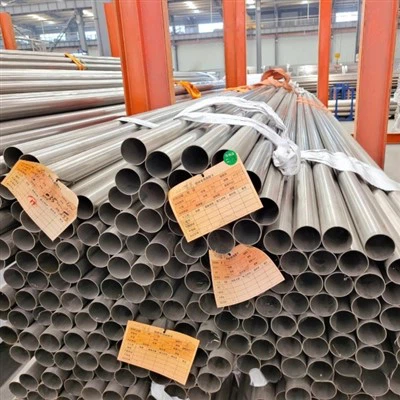
Duplex 2205 vs Super Duplex 2507: Differences, Selection Guide & Applications
Specify Duplex 2205 (UNS S32205) for mild chlorides, ambient-temperature topside seawater, dilute acid and structural duty where cost matters. Choose Super Duplex 2507 (UNS S32750) for continuous or warm seawater immersion, subsea wetted parts, hot high-chloride brine, or combined sour-gas plus chloride service. The dividing line is PREN 40 : 2205 sits near 34–35, 2507 at 40–42, and most offshore specifications require PREN ≥ 40 for submerged seawater duty.
|
If your service is… |
Specify |
Why |
|
Topside seawater cooling, <25 °C, free-flowing |
Duplex 2205 |
PREN ~35 is adequate; material cost is lower |
|
Continuous seawater immersion, warm (>20–25 °C) |
Super Duplex 2507 |
Meets PREN ≥ 40 rule; 2205 crevices pit |
|
Subsea manifolds / flowlines (NORSOK, DNV-OS-F101) |
Super Duplex 2507 |
Specification and CCT margin demand super duplex |
|
Process brine >50,000 ppm Cl⁻ with heat |
Super Duplex 2507 |
2205 chloride ceiling is far lower |
|
Dilute acid storage, ambient, low chloride |
Duplex 2205 |
Ample corrosion margin at lower price |
|
Sour gas (H₂S + CO₂), no seawater |
Duplex 2205* (verify envelope) |
NACE-qualified; 2507 not required |
|
Sour gas + seawater + subsea |
Super Duplex 2507 |
Combined chloride/sour duty needs PREN 40+ |
|
Structural (hangers, tensioners) |
Duplex 2205 |
Better ductility and lower cost |
An EPC engineer contacted us this spring with two quotes for a seawater cooling header - one in 2205, one in 2507, the latter about 40% higher. "Do I actually need the premium grade, or is this just margin?" The answer depends entirely on where the pipe lives. That header ran through a warm Gulf intake with stagnant crevices - exactly where 2205 develops pitting within a few years, so the 2507 premium bought the full design life. On a separate job, a topside wash-water line at 18 °C needed nothing beyond 2205. Same two grades, opposite right answer.
About Henan TOM Intelligent Technology Co., Ltd.
TOM is a stockist and exporter of duplex and super duplex stainless materials, supplying pipes, plates, round bars, butt-weld fittings and flanges with EN 10204 3.1 MTC and PMI verification. Contact us for current prices and lead times.

Related products:
Products Description
Both are 50/50 ferritic-austenitic stainless steels and both roughly double the yield of 316L, so datasheets look similar at a glance. The difference is not cosmetic - it decides whether a seawater line pits in year two or runs the full 25-year design life.
|
Parameter |
Duplex 2205 (S32205) |
Super Duplex 2507 (S32750) |
What it means |
|
Family |
Standard duplex (22% Cr) |
Super duplex (25% Cr) |
Higher Cr/Mo/N = stronger corrosion resistance |
|
UNS number |
S31803 / S32205 |
S32750 |
S32205 is the modern, tighter version of 2205 |
|
Werkstoff No. |
1.4462 |
1.4410 |
European material numbers |
|
Common name |
Duplex 2205 |
SAF 2507® (F53) |
2507 is the well-known super duplex grade |
|
Typical ASTM |
A790/A928, A815, A182 F60, A240 |
A790, A815 WP32750, A182 F53, A240 |
Same product families, different grade |
|
Chromium (Cr) |
22.0 – 23.0% |
24.0 – 26.0% |
Core element for pitting resistance |
|
Molybdenum (Mo) |
3.0 – 3.5% |
3.0 – 5.0% |
2507 resists chlorides better |
|
Nickel (Ni) |
4.5 – 6.5% |
6.0 – 8.0% |
Austenite former; improves toughness |
|
Nitrogen (N) |
0.14 – 0.20% |
0.24 – 0.32% |
Raises PREN and strength |
|
PREN |
~34 – 35 |
≥ 40 |
The single most useful corrosion index |
|
Yield strength |
≥ 450 MPa (65 ksi) |
≥ 550 MPa (80 ksi) |
Both roughly 2× 316L |
|
Tensile strength |
≥ 620 MPa (90 ksi) |
≥ 800 MPa (116 ksi) |
2507 is the stronger of the two |
|
Elongation |
≥ 25% |
≥ 15% |
2205 is the more ductile grade |
Chemical Composition and Why It Matters
The extra chromium, molybdenum and nitrogen in 2507 is what lifts its PREN above 40. More molybdenum and nitrogen directly raise resistance to chloride pitting and crevice corrosion.
|
Element |
Duplex 2205 (%) |
Super Duplex 2507 (%) |
Effect |
|
Carbon (C) |
≤ 0.030 |
≤ 0.030 |
Low carbon limits sensitization |
|
Chromium (Cr) |
22.0 – 23.0 |
24.0 – 26.0 |
Primary pitting / general corrosion resistance |
|
Nickel (Ni) |
4.5 – 6.5 |
6.0 – 8.0 |
Austenite former; stabilises toughness |
|
Molybdenum (Mo) |
3.0 – 3.5 |
3.0 – 5.0 |
Key for chloride pitting & crevice resistance |
|
Nitrogen (N) |
0.14 – 0.20 |
0.24 – 0.32 |
Boosts PREN, strength and austenite |
|
Manganese (Mn) |
≤ 2.0 |
≤ 1.20 |
Auxiliary austenite aid, kept modest |
|
Sulfur (S) |
≤ 0.020 |
≤ 0.020 |
Low sulfur aids weldability |
|
Copper (Cu) |
≤ 0.50 |
≤ 0.50 |
Minor; small Cu in some 2507 heats |
|
Iron (Fe) |
Balance |
Balance |
Ferrite former; the base of the structure |
Mechanical Properties and Wall Thickness
Higher strength lets 2507 use thinner walls for the same pressure, partially offsetting its higher material cost. 2205 remains the more ductile grade, which helps forming and structural use.
|
Property (ASTM min) |
Duplex 2205 |
Super Duplex 2507 |
|
Tensile strength |
≥ 620 MPa (90 ksi) |
≥ 800 MPa (116 ksi) |
|
Yield strength (0.2% off.) |
≥ 450 MPa (65 ksi) |
≥ 550 MPa (80 ksi) |
|
Elongation |
≥ 25% |
≥ 15% |
|
Hardness, max |
≤ 290 HB |
≤ 310 HB |
|
Density |
7.8 g/cm³ |
7.8 g/cm³ |

Corrosion Resistance: The PREN and CPT Gap
PREN tracks the critical pitting temperature (CPT) and critical crevice temperature (CCT). 2507's PREN ≥ 40 gives it roughly 10–15 °C higher CPT than 2205 - the margin that separates a reliable seawater system from one that fails.
|
Service condition |
Duplex 2205 |
Super Duplex 2507 |
Verdict |
|
Ambient topside seawater, flowing |
Good |
Excellent |
2205 is acceptable |
|
Warm seawater immersion (>20 °C) |
Risk at crevices |
Safe |
2507 recommended |
|
Subsea / buried, wet |
Not advised |
Required |
2507 only |
|
Brine with heat (>60 °C) |
Limited |
Reliable |
2507 |
|
Sour gas + chloride |
Borderline |
Robust |
2507 |
|
Dilute sulfuric / phosphoric acid |
Good |
Good |
Either grade |
|
Atmospheric / structural |
Good |
Good |
2205 (cost-driven) |
|
Sustained >250 °C |
Avoid (embrittlement) |
Avoid |
Neither for long term |
|
Desalination RO / MSF |
Borderline |
Preferred |
2507 |

Welding and Fabrication
Both grades are welded with matching or overalloyed 2209 filler. Keep heat input moderate (about 0.5–2.5 kJ/mm) and interpass temperature ≤ 150 °C, with argon root shielding. Pre-heat is not required, and post-weld heat treatment is normally avoided because it can disturb the phase balance. 2507 needs slightly tighter procedure control to preserve PREN and the 40/60 ferrite-austenite balance; a qualified WPS and PMI check are recommended.
Price and Total Cost of Ownership
The material premium for 2507 is real, but thinner walls and avoided failures often recover it over the asset life. Judge the grade on total cost, not the line-item price.
|
Cost view |
Duplex 2205 |
Super Duplex 2507 |
|
Base material cost |
Lower (reference 1.0×) |
~1.3 – 1.8× higher |
|
Wall thickness |
Thicker than 2507 |
Thinner possible → material saving |
|
Fabrication & welding |
Straightforward |
Slightly stricter WPS |
|
Maintenance over 20 yr |
Higher if mis-specified |
Lower in aggressive duty |
|
Failure risk in seawater |
Real if mis-specified |
Minimal |
|
Best value when… |
Mild / ambient chloride |
Harsh chloride & sour service |
2205 vs 2507: Real Application Cases
Offshore topside firewater and utility piping - Duplex 2205
Subsea manifolds and flowlines (North Sea) - Super Duplex 2507
Desalination RO permeate and brine concentrator - Super Duplex 2507 (2507 for the high-chloride streams)
Chemical-plant dilute acid storage - Duplex 2205
FLNG process brine exchangers - Super Duplex 2507
Bridge and architectural structurals - Duplex 2205


Can 2205 Replace 2507?
Only in mild, ambient, low-chloride, non-subsea duty. In any warm, stagnant or submerged seawater service, and in combined sour-gas plus chloride service, 2205 cannot be substituted - the PREN and CPT gaps cause premature pitting and crevice corrosion. When the specification calls for PREN ≥ 40, 2507 (or another super duplex) is required.
Buying Guide: What to Put in Your RFQ
Grade and UNS (S32205 or S32750) plus the ASTM specification (A790 / A815 / A182)
Service conditions: chloride concentration (ppm), temperature, H₂S / CO₂, stagnant or flowing
Dimensions, schedule, quantity and end preparation
MTC to EN 10204 3.1, PMI, and UT/MPI as required
Third-party inspection (SGS / TÜV / BV / DNV) if the project demands it
Surface finish, marking and seaworthy packaging
Selection Decision Checklist
Continuous or warm seawater, or subsea? → Super Duplex 2507
Specification requires PREN ≥ 40? → Super Duplex 2507
Ambient, free-flowing, mild chloride? → Duplex 2205
Sour gas combined with chloride? → Super Duplex 2507
Structural or cost-driven, dry/atmospheric? → Duplex 2205
Uncertain? → request a corrosion and materials assessment before ordering
FAQ
Is 2507 "better" than 2205?
Not universally. 2507 has higher PREN and strength, so it wins in warm, submerged or sour chloride service. In mild, ambient, free-flowing duty, 2205 is the better-value choice. "Better" depends on the service, not the grade.
What does PREN mean, and why ≥ 40?
Pitting Resistance Equivalent Number = %Cr + 3.3×%Mo + 16×%N. It predicts resistance to chloride pitting. 2507 reaches ≥ 40; 2205 lands near 34–35. Many offshore specs mandate PREN ≥ 40 for submerged seawater.
What are the UNS and ASTM codes?
2205 is UNS S32205 (older S31803), Werkstoff 1.4462,常见 ASTM A790/A815/A182 F60/A240. 2507 is UNS S32750, Werkstoff 1.4410 (F53),常见 A790/A815 WP32750/A182 F53/A240.
Which is stronger?
2507: yield ≥ 550 MPa and tensile ≥ 800 MPa, versus 2205's ≥ 450 / ≥ 620 MPa. Both roughly double 316L's yield; 2507 is the stronger of the two.
How much more does 2507 cost?
Typically 30–80% more than 2205 at the material level, before any wall-thickness saving. Over a 20-year life in aggressive service, the lifecycle cost is often lower because failures are avoided.
Can 2205 be used in seawater?
Yes - for ambient, free-flowing topside seawater it is widely used. For warm, stagnant or continuously immersed seawater, especially subsea, 2507 is the safer specification.
What temperature can each handle?
Both are used from cryogenic up to about 250 °C. Above ~250–300 °C the ferrite-austenite balance can embrittle, so long-term high-temperature duty is avoided for both.
Which filler metal for welding?
2209 (ER2209 / E2209) is the standard matching/overalloyed filler for both 2205 and 2507. Control heat input (about 0.5–2.5 kJ/mm) and interpass temperature (≤ 150 °C).
Does 2507 need post-weld heat treatment?
Normally no. PWHT is generally not required and can disturb the phase balance. A qualified WPS, argon root shielding and PMI verification are the usual controls.
Is 2507 weldable?
Yes. It is welded like other duplex grades with 2209 filler and controlled heat input. Slightly tighter procedure control preserves PREN and the 40/60 ferrite-austenite balance.
Do both meet NACE MR0175 / ISO 15156?
Both can be supplied to meet NACE MR0175 / ISO 15156 for sour service within defined environmental envelopes. Always confirm the specific H₂S partial pressure and chloride limits with the mill.
Can you weld 2205 to 2507?
It is possible using 2209 filler, but it is normally avoided unless necessary because the two grades have different PREN and strength. Where used, qualify the procedure and apply the lower grade's limits.
Which lasts longer in seawater?
In continuously immersed or warm seawater, 2507 lasts markedly longer because of its PREN ≥ 40 and higher critical pitting/crevice temperatures. In ambient topside duty, 2205 performs well for the full design life.
Is 2507 worth the premium for desalination?
Usually yes for the high-chloride streams (brine, concentrate, evaporator). For low-chloride permeate or ambient parts, 2205 can be specified to control cost without sacrificing reliability.