Products Description
Cylindrical interior spraying study
±25 → ±16 μm
Thickness SD
+66.2%
Operating efficiency
−18.6%
Energy use
−40%
VOC emissions
Municipal water rehabilitation
18 → <7 μm
DFT standard dev.
22% → 9%
Material loss
Ductile iron pipe mill
±10 μm
Film error held
+70%
Throughput
+15–20%
Coating use
Manual interior spraying of large-diameter pipe is a process defined by variability. The operator cannot see the full interior surface, adjusts spray distance by feel, and fatigues over long shifts. The resulting thickness distribution is wide enough that coating specifications are typically written with generous lower tolerance limits-limits that automated systems are expected to tighten.
The data gap between manual and automated application is measurable. In one comparative study of cylindrical interior spraying, the coating thickness standard deviation fell from ±25 μm with manual spraying to ±16 μm with an automated system, alongside a 66.2% increase in operating efficiency, an 18.6% reduction in energy consumption, and a 40% reduction in VOC emissions. In a municipal water pipeline rehabilitation project, dry film thickness standard deviation dropped from 18 μm to under 7 μm after switching to a robotic spraying system, while coating material loss fell from 22% to approximately 9%. For a ductile iron pipe producer using a robotic interior coating system, film thickness error was held to within ±10 μm, single-pipe throughput rose by over 70%, and coating utilization improved by 15–20%.
These are not marginal improvements. Coating material loss directly reduces consumable cost. Thickness consistency reduces the probability of localized under-thickness that would fail holiday detection or accelerate corrosion initiation. And the reduction in rework-less overspray to remove, fewer rejected pipes-compresses the production schedule in ways that are difficult to achieve through manual process discipline alone.
Why the standard matters more than the machine
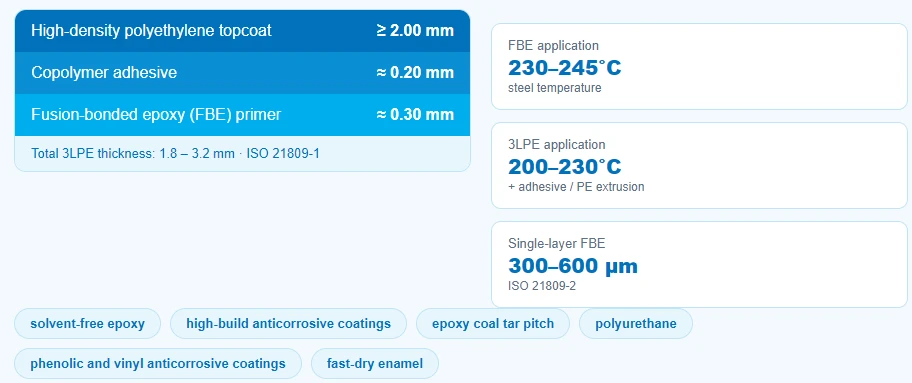
Pipeline coating specifications are not generic. A three-layer polyethylene (3LPE) system conforming to ISO 21809-1 typically comprises a fusion-bonded epoxy (FBE) primer of around 0.30 mm, a copolymer adhesive layer of roughly 0.20 mm, and a high-density polyethylene topcoat of at least 2.00 mm, with total thickness ranging from 1.8 mm to 3.2 mm depending on pipe wall class. Single-layer FBE systems, governed by ISO 21809-2, run 300–600 μm in total thickness. Each layer has a distinct application window: FBE is sprayed onto steel heated to 230–245°C, while 3LPE application requires steel temperatures of 200–230°C, followed by adhesive and PE extrusion that must bond within a narrow thermal window.
An automated spraying system earns its place in this process not by spraying faster, but by holding thickness within the tolerance band that the standard and the project specification demand-layer by layer, pipe after pipe. The equipment must also accommodate the coating chemistry: solvent-free epoxy, high-build anticorrosive coatings, epoxy coal tar pitch, polyurethane, phenolic and vinyl systems, and fast-dry enamel each behave differently under pressure, atomization, and film-build. A robotic platform that cannot be parameterized for viscosity, flow rate, and spray distance across these chemistries is simply a different kind of manual tool.
The application map is wider than oil and gas
Long-distance oil & gas
- High film-build, holiday-free coverage
- Crawl-type systems manage weld-seam transitions
- No speed fluctuation beyond control limits
Municipal water & wastewater
- Access via chambers as small as DN400 to DN600
- Radial contraction ratio 2.5:1 or higher
- Two-component epoxy, 30–45 min pot life
Pipe mills (production lines)
- Cycle-time sync with rollers / ovens
- Nominal 90-second spray cycle
- Up to 25 s auxiliary gun-entry & positioning
Pipeline coating robots are often discussed in the context of oil and gas transmission lines, but the installed base spans a broader set of use cases, each with its own constraints.
Long-distance oil and gas lines demand high film-build and strict holiday-free coverage over long pipe sections; crawl-type spraying systems operating on the pipe interior must manage weld seam transitions without speed fluctuation exceeding control limits. Municipal water and wastewater rehabilitation operates under a different constraint: access. Equipment must pass through inspection chambers as small as DN400 to reach DN600 host pipes, requiring radial contraction ratios of 2.5:1 or higher, and must handle two-component epoxy systems with pot lives as short as 30–45 minutes without automated mixing and flushing. Pipe mills integrating robotic spraying into production lines face a third constraint: cycle time synchronization with rollers, curing ovens, and handling systems, where a nominal 90-second spray cycle can be undermined by 25 seconds of auxiliary gun-entry and pipe-positioning time.
Where the technology is heading
Closed-loop thickness control
Non-contact sensors behind the gun feed data to a PID controller for real-time parameter correction.
Digital twin
Pipeline CAD imported into a virtual spray environment; real-time speed, flow and film thickness vs. simulated baseline.
Multi-modal positioning
Inertial measurement + ultra-wideband baselines + error-state Kalman filtering to beat odometry drift.
The current generation of pipeline spraying robots is primarily an execution platform: PLC-controlled motion, remote operation, and parameter memory for repeatable spray passes. The next layer of capability is already visible in patent and research activity. Closed-loop thickness control using non-contact sensors behind the spray gun, feeding thickness data back to a PID controller for real-time parameter correction, is moving from concept toward deployment. Digital twin systems that import pipeline CAD models into a virtual spraying environment and compare real-time speed, flow rate, and film thickness against the simulated baseline are being developed for inner-wall spraying control. Multi-modal positioning-combining inertial measurement, ultra-wideband baselines, and error-state Kalman filtering-is being explored to maintain accurate spray-head location in long or feature-dense pipe runs where odometry alone drifts.
The direction is clear: the robot is becoming a sensing-and-decision node, not merely a motorized spray gun. That shift matters because the economic case for automation strengthens as the system can document what it applied, where it applied it, and whether the result fell within specification-without relying on post-hoc sampling.