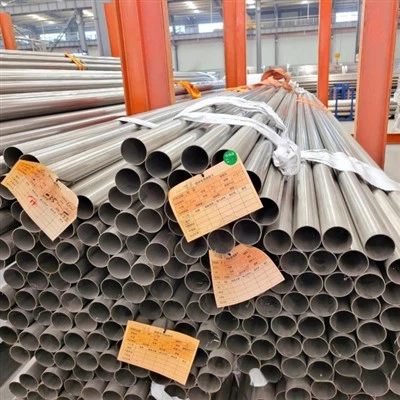
In sour oil and gas environments containing H₂S, CO₂, and chlorides, carbon steel corrosion rates often exceed acceptable limits, while standard austenitic stainless steels such as 316L remain vulnerable to chloride stress corrosion cracking. 2205 duplex stainless steel, with its ferrite–austenite duplex microstructure, offers a compromise between strength and corrosion resistance: a PREN typically around 35–36 and a yield strength of no less than 450 MPa. It has become a "sufficient and not overly expensive" option for medium-to-high-strength sour service applications. However, "selecting 2205" is not the end of the technical decision. What really determines whether a pipe can serve long-term in sour conditions is a layered understanding of the applicable standards and the precision with which three microstructural control points-hardness, phase balance, and traceability-are executed.

Standards Are Not a Single Certificate but a Layered Chain
Compliance for sour-service pipe is often simplified to "meets NACE MR0175." This simplification obscures a key fact: ASTM A790 and NACE MR0175/ISO 15156 address different levels of the problem and cannot substitute for each other.
ASTM A790 - ex-works threshold
- chemical composition
- mechanical properties
- dimensional tolerances
- manufacturing method
NACE MR0175 / ISO 15156 - service qualification
- H₂S partial pressure boundary
- pH and temperature
- heat treatment state
- hardness limit
Hardness and Phase Balance: Two Non-Negotiable Microstructural Control Points
In engineering practice, ferrite content in 2205 welds and heat-affected zones is typically required to be controlled within 40%–60%, ideally close to 1:1. Deviation from this window has consequences in both directions: excessive ferrite reduces toughness and corrosion resistance and raises the risk of Cr₂N precipitation; excessive austenite reduces strength and makes phase transformation behavior during welding thermal cycles harder to predict.
This means that quality assurance for sour-service 2205 pipe cannot stop at "base metal compliance." The phase balance and hardness of welded joints-including weld metal and heat-affected zone-must also be brought into the acceptance scope. A base-metal NACE compliance certificate does not cover the service qualification of welded joints.
Procurement Documentation: From "Having a Certificate" to "Traceable Certification"
In sour-service projects, EN 10204 3.1 certification is a common minimum documentation requirement, but the number "3.1" itself does not automatically equal acceptable traceability depth. NACE MR0175/ISO 15156 applies heat-number-level traceability to sour-service materials, requiring that chemical composition, mechanical properties, and hardness data in the mill certificate correspond one-to-one with the heat number of the physical pipe.
EN 10204 3.1
- issued by the manufacturer's quality department
- suitable for standard piping and utilities
- heat-number-level data correspondence
EN 10204 3.2
- independent third-party witness & joint signature
- sour service, high pressure, severe-consequence scenarios
- specify in procurement specification upfront
The technical threshold for sour-service pipe is rarely about "knowing that 2205 can be used." It is concentrated in "whether it is clear under what conditions 2205 cannot be used, and what evidence proves that it can be used." From standard layering to hardness limits, from the phase-balance window to heat-number traceability, each step is a necessary process for converting "corrosion-resistant material" into "serviceable pipe."
Material standard level
ASTM A790/ASME SA790, UNS S32205/S31803
Service qualification level
NACE MR0175/ISO 15156, measured hardness values and heat treatment conditions
Welded joint level
ferrite content within 40%–60%, welding procedure qualification covering sour-service conditions