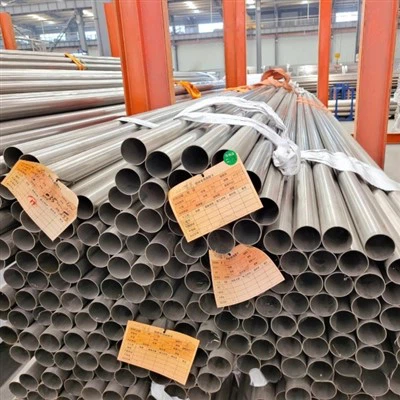
TP347 / TP347H are chromium-nickel austenitic stainless steels stabilized with niobium (Nb, formerly columbium) and a small amount of tantalum (Ta). They are engineered for the 427-815 degC sensitization range and for long-term service above 500 degC. Ordinary austenitic grades such as 304/304L are prone to intergranular corrosion (IGC) in that temperature band, because chromium carbides precipitate at grain boundaries during welding or prolonged exposure, depleting the surrounding chromium. TP347H uses Nb to lock carbon into a stable NbC phase, which blocks the harmful grain-boundary Cr23C6 and simultaneously provides solid-solution strengthening. This makes it the preferred material for supercritical-boiler superheaters, catalytic-reformer outlet headers, and hydrocracker hydrogen-service lines-where high temperature, pressure and hydrogen coexist.

Key Features
◆ Intergranular corrosion resistance: Nb+Ta stabilization (Nb+Ta >= ~10xC) prevents the formation of grain-boundary Cr23C6 during welding and high-temperature exposure, so corrosion resistance is retained in the as-welded condition-without requiring a full solution anneal.
◆ Superior high-temperature creep strength: 347H's higher carbon (0.04-0.10%) gives solid-solution strengthening; its ASME allowable stress above 538 degC clearly exceeds 304L and is favorable versus 321H, for reliable long-term high-temperature load carrying.
◆ Hydrogen-service friendly: In high-pressure hydrogen environments such as hydrotreaters and reformers, the stabilized structure resists hydrogen attack and polythionic-acid stress-corrosion cracking (SCC), suiting aggressive process media.
◆ Full size range, seamless preferred: Standard covers NPS 1/8"-48", Sch 5S-XXS; for high-temperature, high-pressure hydrogen lines we recommend seamless (SMLS)-no longitudinal weld seam, easier piece-by-piece inspection and full material traceability.
Technical Specifications
Chemical Composition (ASTM A312 typical, %)
|
Element |
TP347 |
TP347H |
Note |
|
C |
<= 0.08 |
0.04 - 0.10 |
347H higher C for high-temp strength |
|
Mn |
<= 2.00 |
<= 2.00 |
- |
|
P |
<= 0.040 |
<= 0.040 |
residual max |
|
S |
<= 0.030 |
<= 0.030 |
residual max |
|
Si |
<= 0.75 |
<= 0.75 |
- |
|
Cr |
17.0 - 19.0 |
17.0 - 19.0 |
passivation film |
|
Ni |
9.0 - 13.0 |
9.0 - 13.0 |
austenite stabilizer |
|
Nb+Ta |
>= 10xC (<=1.10) |
>= 8xC (<=1.10) |
stabilizing element |
Mechanical Properties at Room Temperature (TP347H minimum guaranteed)
|
Property |
Value |
Remark |
|
Tensile strength Rm |
>= 515 MPa |
same bracket as 304H |
|
Yield strength Rp0.2 |
>= 205 MPa |
- |
|
Elongation A (2in) |
>= 35 % |
good ductility |
Dimensions & Manufacturing Range
|
Item |
Range / Description |
|
Outside diameter NPS |
1/8" - 48" (DN6 - DN1200) |
|
Wall thickness Schedule |
Sch 5S - XXS (ASME B36.19M) |
|
Form |
Seamless (SMLS) / Welded (WELD) / Heavily cold-worked (HCW) |
|
Standard |
ASTM A312 / A312M-22 |
|
Common length |
6 m fixed; cut-to-length and beveling available |
|
Surface finish |
Pickled & passivated (AP) or bright-annealed (BA); electropolish optional |
Typical Industrial Applications
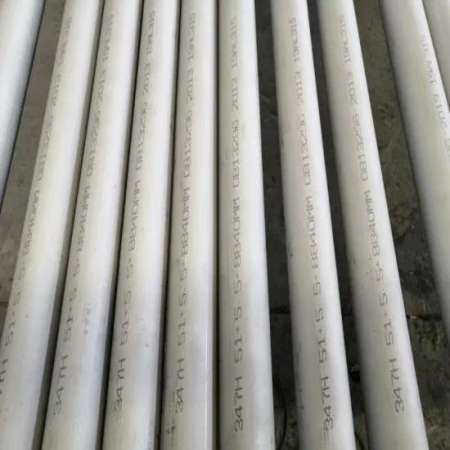
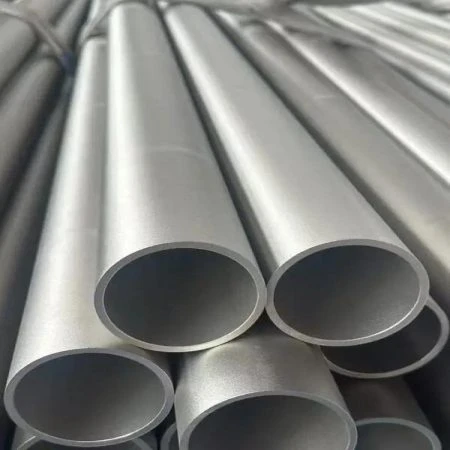
These pipes are used a lot in hydrocracker units and fluid catalytic cracking systems at petrochemical plants, and for ASTM A312 TP347 347H Stainless Steel Pipes, the stabilized grades are essential for resisting intergranular corrosion in high-pressure hydrogen environments above 500°C, with 347H providing the creep rupture strength needed for superheater and reheater tubes in ultra-critical thermal power boilers and for welded fabrications in chemical processing plants handling hot nitric acid and high-temperature organic chemical processes. They are constantly exposed to high-pressure hydrogen and temperatures above 500°C. Thermal power plants use 347H for superheater and reheater tubes in ultra-critical boilers because it has a high creep rupture strength that is needed for long-term use in extreme thermal cycling. Chemical processing plants that use hot nitric acid and high-temperature manufacturing processes to make fertilisers and organic chemicals depend on stabilized grades to keep welds from breaking down.
Case Study Evidence
In their reformer exit manifolds, a large industrial complex in the Midwest switched from standard 304H pipe to TP347H pipe. After five years of operation at 650°C and cyclic loading, ultrasonic inspection showed no intergranular attack or creep deformation. This confirmed a 30% increase in the expected component lifespan. In the same way, a power plant in the Southeast had no unexpected outages due to tube failures in their 347H superheater sections over eight years of tracking. This was in contrast to their previous 321-grade performance, which meant that the tubes had to be replaced every four to five years.
Grade Comparison: When Does 347H Win?
|
Grade |
Stabilizer |
High-temp strength |
Typical use |
One-line note |
|
304H |
None |
High (high C) |
Non-H2, post-weld solution possible |
Lowest cost; avoid in H2 / as-welded-no-solution cases |
|
321H |
Ti |
Medium-high |
IGC-resistant, general high temp |
Good weldability, but slightly lower high-temp stability than 347H |
|
316 / 316L |
None (316L low C) |
Medium |
Chloride-containing service |
Mo promotes sigma phase; dry oxidation >600 degC worse than 347 |
|
347 |
Nb+Ta |
Medium |
General high-temp IGC (long-term <500 degC) |
Balanced choice when budget & temp are moderate |
|
347H |
Nb+Ta |
Highest |
>500 degC H2 / supercritical |
The 'standard answer' for high-temp H2 long-cycle service |
TP347 vs. TP304 and TP304L
Although TP304 is cheaper to make and has good resistance to rust in general, it is not stabilized and can become sensitive during welding or service at temperatures between 427°C and 815°C. The carbon percentage in TP304L is lowered to lower the chance of sensitization, but the high-temperature strength is lost. Columbium stabilization makes TP347 completely immune to sensitization issues. This makes it the best choice for welded structures that will be used at high temperatures, even though it costs 15-20% more.
TP347 vs. TP316 and TP316L
TP316 types have 2 to 3 percent molybdenum added to them to make them more resistant to pitting and crevice corrosion in chloride conditions. Molybdenum, on the other hand, helps form the sigma phase when exposed to temperatures above 600°C for a long time. This makes the metal less tough and resistant to corrosion. This doesn't happen with TP347 because it has better resistance to oxidation and weldability in high-heat situations. This means it works better in dry, high-temperature oxidizing environments than in wet chloride service.
TP347 vs. TP321
TP347 and TP321 are both stabilized grades that are meant to keep people from becoming too sensitive. Titanium stabilization is used in TP321, which can cause titanium nitride to form during welding. This can make the joint less solid by causing holes. Columbium in TP347 stays more stable and doesn't give off gases as easily while welding. This makes the welds cleaner and stronger. Field welding output goes up because pre-heating and post-weld heat treatment aren't needed as much as they were with TP321.
TP347 vs. TP309 and TP310
The TP309 and TP310 types have more chromium and nickel, which makes them resistant to rusting and carburization at temperatures above 870°C. However, the higher metal content makes the material cost 40–60% more than TP347. For uses that stay below 870°C all the time, TP347 and TP347H offer enough oxidation protection at a much lower cost, making the lifetime cost-effectiveness optimal without lowering safety margins.
Manufacturing & Heat Treatment
Heat treatment: Solution anneal at >= 1040 degC followed by water quench (rapid cooling locks the austenite and prevents carbide precipitation during slow cooling)-this is the prerequisite for 347H properties; always verify the solution temperature on the MTC.
Form choice: For high-temperature, high-pressure hydrogen critical lines, seamless pipe is preferred; with no longitudinal seam as a potential weak link, overall reliability is higher and piece-by-piece hydrostatic and UT inspection is easier.
Welding: If welding is involved, 347H normally needs no preheat; for heavy walls (>Sch 80) or highly restrained joints, consider PWHT to relieve residual stress.
Quality Control & Certification
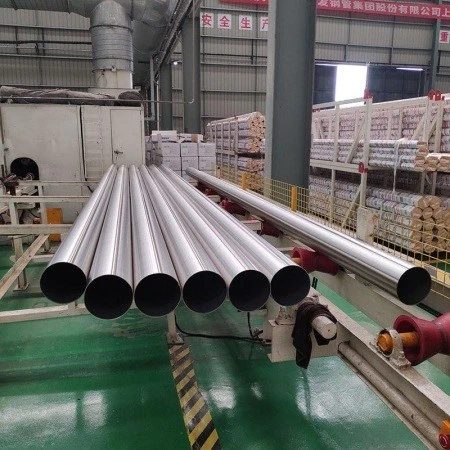
Systems: Manufacturer systems: ISO 9001 quality management and PED (Pressure Equipment Directive) compliance; preferably with an ISO 17025 accredited in-house laboratory.
Documents: Material certificate to EN 10204 3.1 (maker's cert) or 3.2 (third-party witnessed); must state solution temperature, carbon range and Nb+Ta ratio.
Inspection: Special tests: intergranular corrosion test (e.g. ASTM A262), high-temperature tensile, grain-size rating (ASTM E112); NDT including hydrostatic / eddy-current / ultrasonic.
Authenticity: Incoming verification: portable XRF for PMI to confirm Nb+Ta ratio on site; cross-check MTR against physical markings to prevent substitution with non-stabilized grades.
Why Choose Us
Sizes: Full size coverage: NPS 1/8"-48", Sch 5S-XXS, seamless/welded forms available;
Qualification: Certifications: ISO 9001 / PED / TUV, with ISO 17025 in-house lab and EN 10204 3.1/3.2 certification;
Quality: Traceable QC: piece-by-piece hydrostatic + UT/ECT, complete MTC and UT records, PMI verification on request;
Delivery: Flexible delivery: low MOQ for samples, stock ships in ~7 days, custom in 4-6 weeks, FOB/CIF/DDP flexible;
Service: Technical support: grade selection, welding & heat-treatment consultation, and BOM review assistance.
FAQ
Q1: TP347 vs 347H?
A: The key difference is carbon-347 has C <=0.08%, 347H is high carbon 0.04-0.10% with solution anneal >=1040 degC; 347H's creep rupture strength at >500 degC long-term service exceeds 347.
Q2: Can it be used at low temp?
A: Yes. The austenitic structure does not embrittle at low temperature; 347H is usable down to about -196 degC, suitable for cryogenic-to-high-temp cyclic service.
Q3: How to verify authenticity?
A: Check the solution temperature and C/Nb+Ta ratio on the MTR; use portable XRF for PMI on site to confirm the stabilizer; request the ASTM A262 intergranular corrosion report from the supplier.
Q4: Preheat needed before welding?
A: Usually no preheat is needed; only heavy walls (>Sch 80) or highly restrained joints call for PWHT to relieve residual stress.
Q5: Why 347H over 321?
A: 347H uses Nb stabilization-fewer TiN porosity in the weld, no special shielding gas, essentially no preheat, and better long-term high-temp stability-which is why it is progressively replacing 321.