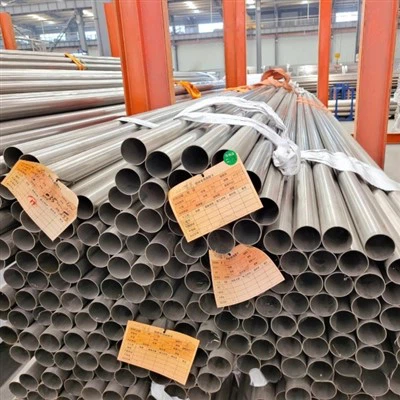
"High performance alloy fittings" is the umbrella term for elbows, tees, reducers, caps, flanges and branch outlets made from alloys engineered for service that ordinary carbon steel or even standard 304 stainless cannot survive-severe corrosion, sustained high temperature, or high pressure. They are the connectors that keep a corrosion-resistant or high-temperature piping system intact, so their material and quality must match the pipe they join.
What counts as a "high performance" alloy?
High performance alloys sit above commodity stainless. They rely on higher chromium, molybdenum, nickel and sometimes nitrogen (or cobalt/tungsten) to resist pitting, crevice corrosion, stress-corrosion cracking (SCC), and high-temperature oxidation/carburization. The families most used for fittings are:
Austenitic stainless (316L, 317L, 321, 347H, 310S) - the workhorse CRAs.
Duplex & super duplex (2205, 2507) - high strength + chloride resistance.
Nickel alloys (625, 825, 800H/HT, C276) - for the harshest acid, sour, or ultra-high-temperature duty.
Common high performance fitting alloys
| Grade / Alloy | Family | Key trait | Typical service |
|---|---|---|---|
| 316L (WP316L) | Austenitic SS | PREN ~25, weldable | Chemical, marine, pharma, food |
| 317L | Austenitic SS | PREN 29–31, more Mo | Acidic chloride, FGD, pulp & paper |
| 321 (WP321) | Ti-stabilized austenitic | Stable against sensitization | 400–900 °C, intermittent high temp |
| 347H (WP347H) | Nb-stabilized austenitic | High-temp creep strength | Refinery heaters, boiler tubes |
| 310S | 25Cr-20Ni austenitic | To ~1150 °C | Furnaces, incineration, reformers |
| 2205 (F51 / WP31803) | Duplex | PREN 34–35, ~2× strength | Seawater, desalination, offshore |
| 2507 (F53 / WPS32750) | Super duplex | PREN ~40+ | Aggressive seawater, subsea |
| 625 (N06625 / F625) | Ni-Cr-Mo | Extreme corrosion, high strength | Sour/acid, offshore, exhaust |
| 825 (N08825) | Ni-Fe-Cr-Mo-Cu | Sulfuric / phosphoric acid | Chemical, sour service |
| 800H/HT (N08810/811) | Ni-Fe-Cr | High-temp strength | Furnace, reformer, pyrolysis |
| C276 (N10276 / Hastelloy) | Ni-Mo-Cr superalloy | Near-universal acid resistance | Worst acid + oxidizer duty |
Fitting types & how they are made
The same alloy appears across several fitting families, made by different processes:
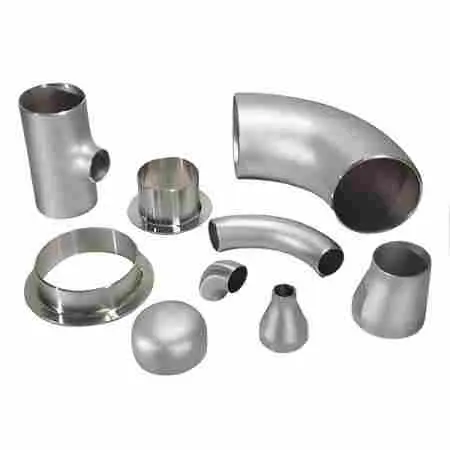
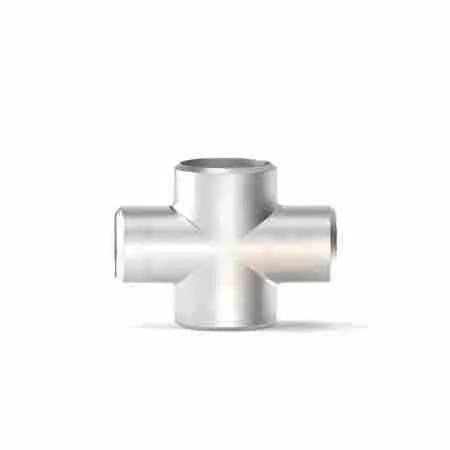
Butt-weld fittings - long/short radius elbows (45°/90°/180°), tees, concentric & eccentric reducers, caps, stub ends (lap-joint), laterals. Formed from seamless pipe or plate, then solution-annealed and pickled.
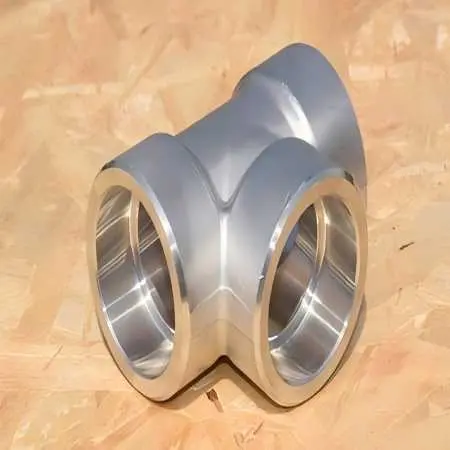
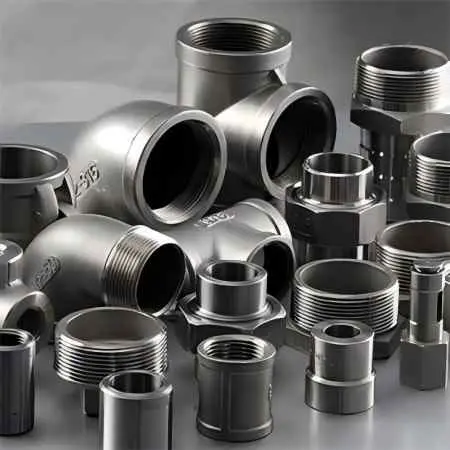
Forged fittings - socket-weld and threaded elbows, tees, couplings, caps, plugs, bushings. Die-forged from bar, used where higher pressure integrity is needed.
Forged flanges - weld neck, slip-on, blind, socket-weld, threaded, lap-joint, long weld neck, orifice. Rated to ASME flange classes (150–2500).
Branch outlets (olets) - weldolet, threadolet, sockolet, reinforced nozzles per MSS SP-97.
The standards behind the fitting
| Standard | Scope |
|---|---|
| ASTM A403 / SA403 | Wrought austenitic stainless butt-weld fittings (WP304/316L/317L/321/347/310S; seamless WP-S or welded WP-W) |
| ASTM A182 / SA182 | Forged flanges & forged fittings, alloy & stainless (incl. duplex F51/F53, chrome-moly F11/F22) |
| ASTM B366 / SB366 | Wrought nickel-alloy butt-weld fittings (625/825/800H/C276) |
| ASTM B564 | Nickel-alloy forgings (flanges, forged fittings) |
| MSS SP-43 | Wrought stainless steel butt-weld fittings for corrosion service (lightweight) |
| MSS SP-97 | Integrally reinforced forged branch outlet fittings (olets) |
| ASME B16.9 | Dimensions of factory-made butt-welding fittings |
| ASME B16.11 | Forged socket-welding & threaded fittings |
| ASME B16.5 / B16.47 | Pipe flanges and flanged fittings (rating & dimensions) |
| NACE MR0175 / ISO 15156 | Sour-service (H₂S) material limits |
How to specify high performance alloy fittings
Match the grade to the pipe - at minimum, equal corrosion resistance; often one step up (e.g., 316L pipe with 317L or 625 fittings in the worst zones).
Match the form to the joint - butt-weld for welded lines, forged socket/threaded for instrument and small-bore high-pressure taps, flange class to the line rating.
State the schedule / wall - fittings must match pipe wall thickness (SCH 10S to XXS, or SMLS heavy wall).
Flag the service - chlorides, acid type/concentration, temperature, H₂S/CO₂ partial pressure, so the supplier confirms PREN and NACE compliance.
Require heat treatment & finish - solution-annealed + pickled/passivated; electropolished for hygienic/pharma service.
Where they are used
Chemical & petrochemical - 316L/317L/C276 for acid lines.
Offshore & desalination - 2205/2507 and 625 for seawater.
Power & heat exchangers - 321/347H/800H for high temperature.
FGD & pulp & paper - 317L and high-alloy austenitics.
Pharmaceutical & food - 316L, high surface finish.
Conclusion
High performance alloy fittings are not a line item to buy on price-they are the joints that determine whether a corrosion-resistant or high-temperature system survives. Choose the alloy by PREN and service chemistry, specify the correct ASTM/ASME standard and form, and insist on PMI and mill certificates. Do that, and the whole spool-pipe, fitting and flange-stays corrosion-critical and code-compliant.