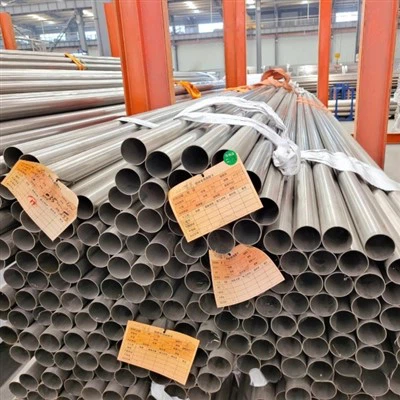
A complete guide to seamless steel pipe - covering the manufacturing process, material grades, applicable standards, size ranges, and key considerations for procurement.
1. Introduction
Seamless steel pipe is one of the most fundamental and widely specified products in industrial piping. From oil and gas transmission to power generation boilers, chemical processing plants to hydraulic systems, seamless pipe is specified wherever strength, reliability, and pressure integrity are critical.
Unlike welded pipe, seamless pipe has no longitudinal or spiral weld seam - it is formed from a single solid steel billet. This eliminates the weld as a potential failure point and produces a pipe with uniform mechanical properties throughout.
This guide covers everything engineers and procurement professionals need to know about seamless steel pipe.
2. What Is Seamless Steel Pipe?
A seamless steel pipe is a hollow cylindrical tube manufactured without a welded seam. It is produced by heating a solid steel billet and piercing it with a mandrel to create a hollow shell, which is then rolled or drawn to the desired dimensions. Because there is no weld, the pipe has uniform wall thickness and consistent metallurgical properties around the entire circumference.
Key Characteristics
- No weld seam - eliminates the weld as a potential failure point
- Uniform grain structure and mechanical properties
- Higher allowable pressure than welded pipe of the same grade and schedule (Ej = 1.0 per ASME B31.3)
- Better performance under cyclic loading, high temperature, and sour service
- Higher cost due to more complex manufacturing and lower material yield
3. Seamless Pipe Manufacturing Process
Step 1: Billet Preparation
A solid cylindrical steel billet is cut to length and heated in a rotary hearth furnace to approximately 1200°C (2190°F). The uniform heating is critical to achieve consistent plasticity for piercing.
Step 2: Piercing
The heated billet is fed into a cross-roll piercing mill where two rotating rolls and a stationary mandrel pierce the center, creating a hollow shell. This is the most technically demanding step - any eccentricity here carries through to the finished pipe.
Step 3: Elongation
The hollow shell is elongated through a mandrel mill, plug mill, or continuous rolling mill. Multiple passes reduce the wall thickness and outer diameter to the target dimensions.
Step 4: Sizing & Straightening
The pipe passes through a sizing mill to achieve the final OD within standard tolerances, then is straightened to meet straightness requirements.
Step 5: Heat Treatment
Depending on the specification, the pipe undergoes normalizing, quenching and tempering, or stress relieving to achieve the required mechanical properties and grain structure.
Step 6: Testing & Inspection
Each pipe is subjected to hydrostatic pressure testing, and the weld area (for seamless, the entire body) is inspected using ultrasonic, eddy current, or magnetic particle methods. Dimensional verification and visual inspection complete the process.
| Manufacturing Parameter | Typical Value |
|---|---|
| Billet temperature | 1200°C |
| Piercing speed | 0.5 – 2.0 m/s |
| Reduction ratio | 4:1 to 10:1 per pass |
| Normalizing temperature | 850 – 950°C |
| Hydrostatic test pressure | Per ASTM/API specification (typically 1.5× design pressure) |
4. Material Grades
Carbon Steel Seamless Pipe
| Grade | Standard | Tensile Strength | Max Temp |
|---|---|---|---|
| A106 Gr. B | ASTM A106 | 415 MPa min | 425°C |
| A53 Gr. B | ASTM A53 | 415 MPa min | 425°C |
| API 5L Gr. B | API 5L | 415 MPa min | 400°C |
| API 5L X52 | API 5L | 460 MPa min | 400°C |
| API 5L X65 | API 5L | 535 MPa min | 400°C |
| API 5L X80 | API 5L | 625 MPa min | 400°C |
Stainless Steel Seamless Pipe
| Grade | Standard | Key Property | Application |
|---|---|---|---|
| 304/L | ASTM A312 | General corrosion resistance | Food, chemical, architectural |
| 316/L | ASTM A312 | Chloride resistance (Mo added) | Marine, pharmaceutical |
| 321 | ASTM A312 | High-temp stability (Ti stabilized) | Aerospace, heat exchangers |
| 310S | ASTM A312 | Oxidation resistance to 1035°C | Furnace parts, kilns |
Alloy Steel Seamless Pipe
| Grade | Standard | Key Property | Max Temp |
|---|---|---|---|
| P5 (5Cr-0.5Mo) | ASTM A335 | Oxidation resistance | 650°C |
| P9 (9Cr-1Mo) | ASTM A335 | High-temp corrosion resistance | 650°C |
| P11 (1.25Cr-0.5Mo) | ASTM A335 | Creep resistance | 575°C |
| P22 (2.25Cr-1Mo) | ASTM A335 | Creep + hydrogen resistance | 575°C |
| P91 (9Cr-1Mo-V) | ASTM A335 | High creep strength | 650°C |
5. Applicable Standards
| Standard | Scope |
|---|---|
| ASTM A106 | Seamless carbon steel pipe for high-temperature service |
| ASTM A53 | Seamless and welded black and hot-dipped galvanized steel pipe |
| API 5L | Line pipe for oil and gas transmission (PSL1 and PSL2) |
| ASTM A312 | Seamless and welded austenitic stainless steel pipe |
| ASTM A333 | Seamless and welded steel pipe for low-temperature service |
| ASTM A335 | Seamless ferritic alloy steel pipe for high-temperature service |
| ASTM A213 | Seamless ferritic and austenitic boiler, superheater, and heat-exchanger tubes |
| EN 10216 | Seamless steel tubes for pressure purposes (European) |
| DIN 17175 | Seamless steel tubes for elevated temperatures (German) |
| JIS G3454 | Carbon steel pipe for pressure service (Japanese) |
| GB/T 8163 | Seamless steel pipes for liquid service (Chinese) |
6. Size & Schedule Range
Seamless steel pipe is available from as small as 1/8" NPS (instrument tubing) up to 36" NPS (large-diameter transmission pipe). Above 36", seamless pipe becomes economically impractical - LSAW or SSAW welded pipe is used instead.
| NPS | OD (inches) | Schedule Range |
|---|---|---|
| 1/2" | 0.840 | Sch 40 – Sch 160 |
| 1" | 1.315 | Sch 40 – Sch 160 |
| 2" | 2.375 | Sch 10 – Sch 160 |
| 4" | 4.500 | Sch 10 – Sch 160 |
| 6" | 6.625 | Sch 10 – Sch 120 |
| 8" | 8.625 | Sch 10 – Sch 120 |
| 12" | 12.750 | Sch 10 – Sch 80 |
| 24" | 24.000 | Sch 10 – Sch 60 |
| 36" | 36.000 | Sch 10 – Sch 40 |
7. Seamless vs Welded Pipe
| Property | Seamless Pipe | Welded Pipe |
|---|---|---|
| Weld seam | None | Longitudinal or spiral |
| Pressure rating | Higher (Ej = 1.0) | Lower (Ej = 0.85 – 1.0) |
| Diameter range | 1/8" – 36" | 1/2" – 120" (SSAW) |
| Wall uniformity | Excellent | Good (weld zone may vary) |
| Cost | 20-40% premium | Lower |
| Lead time | Longer | Shorter |
| Sour service (NACE) | Preferred | Limited (HAZ concern) |
| Fatigue resistance | Excellent | Good |
8. Applications of Seamless Steel Pipe
Oil & Gas
Seamless pipe is the standard for downhole casing and tubing, wellhead connectors, flowlines, and high-pressure gas transmission. API 5L PSL2 seamless grades X52-X80 are specified for critical pipelines where weld seam integrity cannot be risked.
Power Generation
Boiler tubes (ASTM A213), superheater tubes (ASTM A335 P91), and steam lines in fossil fuel and nuclear power plants rely on seamless pipe for high-temperature creep strength.
Chemical & Petrochemical
Seamless stainless steel pipe (ASTM A312 TP304L/316L) is used in process piping for corrosive chemical service. Alloy grades (P5, P9) handle high-temperature hydrogen service in refineries.
Hydraulic & Pneumatic
Seamless cold-drawn pipe is specified for high-pressure hydraulic cylinders, instrumentation tubing, and pneumatic control lines where surface finish and concentricity are critical.
Mechanical & Structural
Seamless mechanical tubing is used for shafts, rollers, bearing races, and structural components requiring uniform strength without a weld seam.
9. Procurement Checklist
When ordering seamless steel pipe, ensure the following information is included in your RFQ:
- Quantity - Number of lengths or total tonnage
- Standard - ASTM A106, API 5L, ASTM A312, etc.
- Material Grade - Gr. B, X52, TP304L, P22, etc.
- Size - NPS + Schedule, or exact OD × wall thickness
- Length - Single random, double random, or fixed lengths
- End Finish - Plain, beveled, or threaded
- Certification - EN 10204 3.1 or 3.2, NACE MR0175
- Testing - Hydrostatic, UT, PMI, or third-party inspection
- Coating - Bare, varnished, galvanized, FBE, or 3LPE
- Delivery - Incoterm (FOB, CIF, CNF) and port of destination
10. Frequently Asked Questions
Q: What is the difference between seamless and welded steel pipe?
A: Seamless pipe is made from a solid billet with no welded seam, giving it higher pressure integrity and uniform structure. Welded pipe is formed from plate or coil with a longitudinal or spiral weld. Seamless is stronger per ASME B31.3 (Ej = 1.0) but costs 20-40% more.
Q: What sizes does seamless pipe come in?
A: Seamless pipe ranges from 1/8" NPS to 36" NPS (6mm to 914mm OD). Above 36", seamless is generally not economical - welded pipe (LSAW or SSAW) is used instead.
Q: What is the maximum temperature for seamless carbon steel pipe?
A: ASTM A106 Gr. B is suitable up to 425°C (800°F). For higher temperatures, alloy steel grades such as ASTM A335 P11 (575°C), P22 (575°C), or P91 (650°C) are required.
Q: What is the difference between ASTM A106 and ASTM A53 seamless pipe?
A: ASTM A106 is specifically intended for high-temperature service and includes additional chemical requirements (silicon content). ASTM A53 covers both seamless and welded pipe for general mechanical and pressure applications. A106 is the more common specification for process piping.
Q: Is seamless pipe required for sour service (NACE)?
A: Seamless pipe is strongly preferred for NACE MR0175 sour service environments because there is no weld heat-affected zone (HAZ) that could be susceptible to sulfide stress cracking (SSC). Welded pipe can be used with additional NACE-compliant weld procedures and hardness testing.
Q: What is a Mill Test Report (MTR)?
A: An MTR is a certified document from the mill that reports the chemical composition and mechanical properties of the heat of steel from which the pipe was produced. EN 10204 3.1 MTRs include independent inspection certification. Always request MTRs with your seamless pipe order.
11. Why Choose Shuangzhong for Seamless Steel Pipe?
Henan Shuangzhong Intelligent Technology Co., Ltd. supplies seamless steel pipe to global customers in North America, Europe, the Middle East, and Southeast Asia. Our capabilities include:
- Comprehensive Grade Range - Carbon steel (A106, A53, API 5L), stainless steel (A312), and alloy steel (A335 P grades)
- Full Certification - ISO 9001:2015, API Q1, EN 10204 3.1 MTRs
- Custom Sizes - Non-standard diameters and schedules available
- One-Stop Supply - Pipe, fittings, flanges, and fasteners from a single source
- Competitive Pricing - Factory-direct pricing with no middleman
- Ready to source seamless steel pipe? Request a quote and our team will respond within 24 hours.
Email: sarah@manufacturerpipe.com
WhatsApp: +86 19069638227
Related:
Stainless Steel Pipe | Carbon Steel Pipe | Alloy Steel Pipe