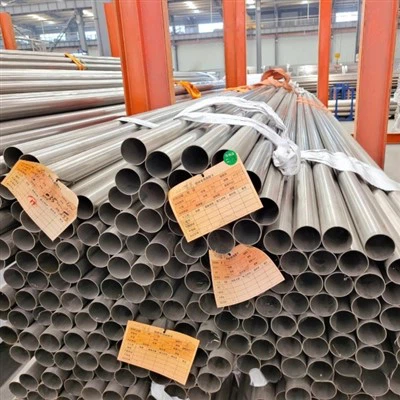
A comprehensive guide to ERW steel pipe - covering the electric resistance welding process, material grades, applicable standards, size ranges, applications, and how to specify ERW pipe for your project.
1. Introduction
ERW steel pipe (Electric Resistance Welded pipe) is the most widely used type of welded steel pipe in the world. Produced by cold-forming steel coil into a cylindrical shape and welding the longitudinal seam using high-frequency electric current, ERW pipe offers an excellent balance of cost, availability, dimensional accuracy, and mechanical performance.
From water transmission lines and structural supports to oil and gas gathering systems, ERW pipe accounts for the majority of steel pipe consumed globally. This guide provides everything you need to know about specifying, sourcing, and using ERW steel pipe.
2. What Is ERW Steel Pipe?
ERW steel pipe is manufactured by cold-forming a flat steel strip (coil) into a cylindrical shape and passing a high-frequency electric current through the edges to heat them to welding temperature. The edges are then forged together under pressure to create a solid-state bond - no filler metal is added. After welding, the internal and external weld flash is removed, and the weld zone is heat-treated to restore ductility.
Key Characteristics
- High production speed - coil-fed process produces pipe at 30-60 m/min
- Excellent dimensional tolerances - cold-formed process yields consistent OD and wall
- Smooth surface finish - no hot rolling scale, cleaner than seamless
- No filler metal - the weld is a forged bond of the base material itself
- Long continuous lengths - coil stock enables longer pipes, reducing field welds
3. ERW Pipe Manufacturing Process
Step 1: Coil Preparation
Hot-rolled or cold-rolled steel coil is selected to the required material specification. The coil edges are trimmed to ensure uniform width and clean edge condition for welding.
Step 2: Forming
The strip passes through a series of forming rolls that progressively bend it into an open cylindrical shape. The forming sequence includes breakdown, edge bending, and fin-pass rolls that bring the edges into precise alignment for welding.
Step 3: High-Frequency Welding
As the formed strip exits the fin-pass rolls, a high-frequency electric current (typically 200-400 kHz) is applied via induction coils or contact tips. The current concentrates along the V-shaped weld point, heating the edges to approximately 1400°C (melting temperature). Squeeze rolls forge the molten edges together, expelling excess material and creating a solid-state bond.
Step 4: Weld Annealing
The weld zone is induction-heated to approximately 950°C and then water-quenched. This post-weld heat treatment refines the grain structure in the heat-affected zone and restores ductility, ensuring the weld properties match the base metal.
Step 5: Sizing & Straightening
The pipe passes through sizing rolls to achieve the final OD within tolerance, then through a straightening machine to meet straightness requirements.
Step 6: NDT & Hydrostatic Testing
100% of the weld seam is inspected using ultrasonic (UT) or eddy current (EC) testing. Each pipe is then hydrostatically pressure tested to 1.5× the specified design pressure.
Step 7: Finishing
Pipes are cut to length, ends are prepared (plain, beveled, or threaded), and surface treatment is applied as required (varnished, galvanized, or coated).
4. Material Grades
| Grade | Standard | Yield Strength (min) | Tensile Strength (min) |
|---|---|---|---|
| ASTM A53 Gr. B | ASTM A53 | 240 MPa | 415 MPa |
| API 5L Gr. B | API 5L PSL1 | 245 MPa | 415 MPa |
| API 5L X42 | API 5L PSL1/PSL2 | 290 MPa | 415 MPa |
| API 5L X52 | API 5L PSL1/PSL2 | 360 MPa | 460 MPa |
| API 5L X60 | API 5L PSL2 | 415 MPa | 520 MPa |
| API 5L X65 | API 5L PSL2 | 450 MPa | 535 MPa |
| API 5L X70 | API 5L PSL2 | 485 MPa | 570 MPa |
| ASTM A252 Gr. 2 | ASTM A252 | 240 MPa | 415 MPa |
| ASTM A252 Gr. 3 | ASTM A252 | 310 MPa | 455 MPa |
5. Applicable Standards
| Standard | Scope |
|---|---|
| ASTM A53 | Welded and seamless steel pipe - general and pressure applications |
| API 5L | Line pipe for oil and gas transmission - PSL1 and PSL2 |
| ASTM A252 | Welded and seamless steel pipe piles - structural piling |
| EN 10217 | Welded steel tubes for pressure purposes (European) |
| JIS G3444 | Carbon steel tubes for general structural purposes (Japanese) |
| GB/T 3091 | Welded steel pipe for low-pressure fluid transmission (Chinese) |
| AWWA C200 | Steel water pipe 6 in. and larger (American Water Works Association) |
6. Size Range & Availability
| NPS | OD (inches) | Schedule Range | Typical Application |
|---|---|---|---|
| 1/2" – 2" | 0.840 – 2.375 | Sch 10 – Sch 80 | Plumbing, mechanical |
| 2" – 6" | 2.375 – 6.625 | Sch 10 – Sch 80 | Structural, fire protection |
| 6" – 12" | 6.625 – 12.750 | Sch 10 – Sch 60 | Water, oil & gas |
| 12" – 20" | 12.750 – 20.000 | Sch 10 – Sch 40 | Transmission pipelines |
| 20" – 24" | 20.000 – 24.000 | Sch 10 – Sch 40 | Large-diameter water mains |
7. ERW vs Seamless Pipe
| Property | ERW Pipe | Seamless Pipe |
|---|---|---|
| Weld seam | Longitudinal HF-ERW welded | No weld seam |
| Cost | Baseline (lower) | 20-40% higher |
| Pressure rating | Good (Ej = 0.85 per ASME B31.3) | Higher (Ej = 1.0) |
| Dimensional tolerance | Excellent (cold-formed) | Good (hot-formed) |
| Surface finish | Clean, smooth | May have scale (if not pickled) |
| Diameter range | 1/2" – 24" | 1/8" – 36" |
| Lead time | Short (coil-fed production) | Longer (billet scheduling) |
| Sour service | Limited | Preferred |
| Fatigue performance | Good | Excellent |
8. Applications of ERW Steel Pipe
Water Transmission
ERW pipe is the standard choice for municipal water supply lines, irrigation systems, and cooling water circuits. ASTM A53 Gr. B ERW pipe with galvanized or FBE coating provides excellent corrosion resistance in buried or exposed service.
Structural & Piling
ASTM A252 ERW pipe is widely used for foundation piling, caissons, and structural columns. The consistent dimensions and straightness of cold-formed ERW make it ideal for driven pile applications.
Oil & Gas
API 5L ERW pipe is used in gathering lines, distribution networks, and moderate-pressure transmission pipelines. Grades X42 through X70 are available with PSL2 certification for critical service.
Fire Protection
ERW pipe is the standard for automatic sprinkler systems (NFPA 13). ASTM A53 Gr. B ERW is listed by UL and FM for fire protection service.
Mechanical & General
Fencing, scaffolding, handrails, conveyor rollers, and HVAC piping all rely on cost-effective ERW pipe.
9. Frequently Asked Questions
Q: Q: What does ERW stand for?
A: A: ERW stands for Electric Resistance Welding - a process where high-frequency electric current heats the pipe edges to welding temperature, and squeeze rolls forge them together without filler metal.
Q: Q: Is ERW pipe as strong as seamless pipe?
A: A: For the same material grade and wall thickness, seamless pipe has a higher allowable pressure per ASME B31.3 (Ej = 1.0 vs 0.85 for ERW). However, for most standard applications (Class 150-600), ERW pipe can be specified with a slightly heavier schedule to achieve the same design pressure at lower overall cost.
Q: Q: What is the maximum size for ERW pipe?
A: A: ERW pipe is typically available up to 24" NPS (610mm OD). Above 24", LSAW or SSAW pipe is required for welded pipe, or seamless pipe up to 36".
Q: Q: Is ERW pipe suitable for high-pressure gas transmission?
A: A: Yes. API 5L PSL2 ERW pipe in grades X52-X70 is used extensively in natural gas distribution and transmission pipelines operating at pressures up to 1,500 psi. The key is proper specification, NDT, and quality control.
Q: Q: Can ERW pipe be galvanized?
A: A: Yes. ERW pipe can be hot-dip galvanized after manufacturing to provide corrosion protection. Shuangzhong supplies galvanized ERW pipe per ASTM A53 with a zinc coating weight specified per ASTM A123.
Q: Q: What is the difference between ERW and HF-ERW?
A: A: HF-ERW (High-Frequency ERW) uses current at 200-400 kHz, which concentrates the heating at the very edge of the strip for a narrower, higher-quality weld. Standard ERW uses lower frequencies that produce a wider heat-affected zone. HF-ERW is the modern standard and produces superior weld quality.
Q: Q: What testing is performed on ERW pipe?
A: A: Standard testing includes 100% ultrasonic inspection of the weld seam, hydrostatic pressure testing, dimensional inspection, and visual examination. PSL2 pipe adds CVN impact testing, and sour service pipe adds hardness testing per NACE MR0175.
10. Why Choose Shuangzhong for ERW Steel Pipe?
Shuangzhong supplies ERW steel pipe to ASTM A53, API 5L, and ASTM A252 standards at competitive factory-direct prices. We offer:
- Carbon steel ERW pipe in grades B through X70
- Galvanized ERW pipe for corrosion-resistant applications
- Full MTR documentation with EN 10204 3.1 certification
- Fast lead times from coil-fed production
- Custom lengths, coatings, and end finishes
Need ERW pipe for your next project? Contact us for a quote within 24 hours.
Email: sarah@manufacturerpipe.com
WhatsApp: +86 19069638227
Related:
Carbon Steel Pipe | Galvanized Pipe | Pipe Fittings