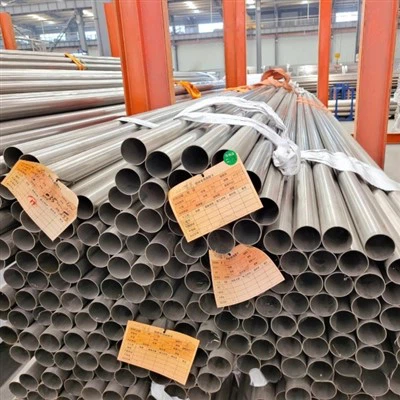
A complete guide to LSAW steel pipe - covering the UOE manufacturing process, material grades, applicable standards, size ranges, applications, and how to specify LSAW pipe for large-diameter high-pressure pipelines.
1. Introduction
When a pipeline project calls for large diameters (16" and above), high pressures, and long-distance transmission, LSAW steel pipe is the standard choice. Longitudinal Submerged Arc Welded (LSAW) pipe combines the strength of plate steel with a high-integrity submerged arc weld to deliver performance that meets the most demanding API 5L PSL2 requirements.
This guide covers everything engineers and procurement professionals need to know about LSAW steel pipe - from the UOE manufacturing process to material selection, coating options, and procurement best practices.
2. What Is LSAW Steel Pipe?
LSAW steel pipe (Longitudinal Submerged Arc Welded pipe) is manufactured from steel plate that is formed into a cylindrical shape and welded along a single longitudinal seam using the submerged arc welding (SAW) process. The weld is created by an electric arc submerged under a layer of granular flux, which protects the molten weld pool from atmospheric contamination and produces a clean, high-quality weld.
The most common forming method is the UOE process: the plate is first pressed into a U-shape, then O-pressed into a cylinder, and finally Expanded to final dimensions. Alternative forming methods include the JCOE process (sequential J-, C-, and O-pressing) for thicker walls.
Key Characteristics
- One longitudinal weld seam (internal + external SAW)
- From steel plate (not coil) - enables thicker walls and higher strengths
- Superior weld quality - submerged arc welding produces defect-free, full-penetration welds
- Excellent dimensional control - mechanical expansion ensures consistent OD
- High toughness - plate material provides better CVN impact properties than coil-based ERW
3. LSAW Pipe Manufacturing Process (UOE)
Step 1: Plate Inspection
Steel plate is received and 100% ultrasonically inspected for laminations and surface defects. Only certified plate with full traceability enters production.
Step 2: Edge Milling
The longitudinal edges of the plate are milled to create a precise X-groove or V-groove weld preparation. The bevel geometry is critical for full-penetration welding.
Step 3: Crimping
The plate edges are pre-formed in a crimping press to approximately the final curvature radius. This ensures the edges align properly during O-pressing.
Step 4: U-Press
The plate is pressed into a U-shape in a hydraulic U-press (typically 4,000 – 10,000 tons capacity). The U-press has a punch and die that form the plate to approximately 75% of the final curvature.
Step 5: O-Press
The U-shaped plate is transferred to the O-press, where a massive hydraulic press (typically 10,000 – 20,000 tons) compresses it into a complete O-shape, bringing the prepared edges into contact.
Step 6: Tack Welding
The seam is tack-welded (typically using MIG or SAW) to hold the O-shape during transport to the welding station.
Step 7: Submerged Arc Welding (Internal & External)
The pipe is welded from the inside first (internal SAW), then from the outside (external SAW). The welding head travels along the longitudinal seam while the pipe remains stationary. Submerged arc welding uses a continuous wire electrode fed under a blanket of granular flux that covers the arc. This produces deep penetration, a clean weld bead, and excellent mechanical properties.
Step 8: Mechanical Expansion
The welded pipe is mechanically expanded by approximately 1% using an internal expanding mandrel. This sets the final OD within tight tolerances (±0.5%), reduces residual stresses, and improves the pipe's fatigue resistance.
Step 9: NDT & Hydrostatic Testing
100% of the weld seam is inspected using automated ultrasonic testing (AUT) from both the internal and external surfaces. Additional NDT includes radiographic testing (RT), magnetic particle testing (MT), and 100% hydrostatic pressure testing.
4. Material Grades
| Grade | Standard | Yield Strength (min) | Tensile Strength (min) | Application |
|---|---|---|---|---|
| API 5L Gr. B | PSL1/PSL2 | 245 MPa | 415 MPa | General transmission |
| API 5L X42 | PSL1/PSL2 | 290 MPa | 415 MPa | Low-pressure lines |
| API 5L X52 | PSL1/PSL2 | 360 MPa | 460 MPa | Gas distribution |
| API 5L X56 | PSL2 | 390 MPa | 490 MPa | Sour service |
| API 5L X60 | PSL2 | 415 MPa | 520 MPa | Oil & gas transmission |
| API 5L X65 | PSL2 | 450 MPa | 535 MPa | High-pressure pipelines |
| API 5L X70 | PSL2 | 485 MPa | 570 MPa | Long-distance transmission |
| API 5L X80 | PSL2 | 555 MPa | 625 MPa | Ultra-high-pressure lines |
5. Applicable Standards
| Standard | Scope |
|---|---|
| API 5L PSL1/PSL2 | Line pipe for oil and gas transmission |
| ISO 3183 | Petroleum and natural gas industries - steel pipe for pipelines |
| ASTM A671 | Electric-fusion-welded steel pipe for atmospheric and lower temperatures |
| ASTM A672 | Electric-fusion-welded steel pipe for high-pressure service at moderate temperatures |
| EN 10208 | Steel pipes for pipelines for combustible fluids |
| DNV-OS-F101 | Submarine pipeline systems (offshore) |
| CSS (Canada) | Canadian pipeline standard (CSA Z245.1) |
6. Size Range
| OD (in) | OD (mm) | Wall Thickness (mm) | Weight per Meter (kg) |
|---|---|---|---|
| 16" | 406.4 | 6.4 – 25.0 | 160 – 625 |
| 20" | 508.0 | 6.4 – 30.0 | 200 – 865 |
| 24" | 609.6 | 6.4 – 35.0 | 240 – 1,190 |
| 30" | 762.0 | 8.0 – 35.0 | 375 – 1,400 |
| 36" | 914.4 | 8.0 – 38.0 | 450 – 1,720 |
| 42" | 1,066.8 | 10.0 – 40.0 | 630 – 2,070 |
| 48" | 1,219.2 | 10.0 – 40.0 | 720 – 2,400 |
| 56" | 1,422.4 | 12.0 – 40.0 | 950 – 2,800 |
| 60" | 1,524.0 | 12.0 – 40.0 | 1,020 – 3,000 |
7. LSAW vs ERW vs SSAW vs Seamless
| Property | LSAW | ERW | SSAW | Seamless |
|---|---|---|---|---|
| Diameter range | 16" – 60" | 1/2" – 24" | 20" – 120" | 1/8" – 36" |
| Wall thickness | 6 – 40mm | 1.5 – 12.7mm | 5 – 25mm | 0.5 – 60mm |
| Raw material | Plate | Coil | Coil | Billet |
| Weld type | Longitudinal SAW | Longitudinal ERW | Spiral SAW | None |
| Pressure rating | High | Medium-High | Medium | Highest |
| Cost index | 1.2 – 1.4 | 1.0 (baseline) | 1.0 – 1.1 | 1.3 – 1.8 |
| Typical use | High-pressure pipelines | General service | Water, piling | Critical service |
8. Applications of LSAW Steel Pipe
Cross-Country Oil & Gas Pipelines
LSAW pipe is the backbone of long-distance hydrocarbon transmission. API 5L X65-X70 LSAW pipe is specified for thousands of kilometers of trunklines worldwide, operating at pressures from 1,000 to 2,500 psi.
Offshore & Subsea
For subsea pipelines and risers, LSAW pipe with DNV-OS-F101 certification provides the required combination of strength, toughness, and fatigue resistance. CTOD (Crack Tip Opening Displacement) testing is typically added to fracture-critical subsea applications.
High-Pressure Gas Storage
LSAW pipe is used in gas storage facilities, including salt cavern and depleted reservoir storage wells, where high pressure and large diameter are required.
Water Transmission
Large-diameter LSAW pipe is used for municipal and industrial water mains where the combination of diameter and pressure exceeds the capability of ductile iron or concrete pipe.
9. Coating Options
| Coating Type | Standard | Application |
|---|---|---|
| 3LPE (Three-Layer Polyethylene) | DIN 30670, ISO 21809 | Standard onshore pipeline coating |
| 3LPP (Three-Layer Polypropylene) | ISO 21809 | High-temperature and offshore lines |
| FBE (Fusion-Bonded Epoxy) | NACE RP0394 | Single or dual-layer for corrosion protection |
| Concrete Weight Coating | DNV-RP-F106 | Subsea negative buoyancy and mechanical protection |
| Internal Lining (epoxy) | API RP 5L2 | Flow efficiency and corrosion protection |
10. Frequently Asked Questions
Q: What does LSAW stand for?
A: LSAW stands for Longitudinal Submerged Arc Welding - the welding process used to join the longitudinal seam of large-diameter pipe under a blanket of granular flux.
Q: What is the UOE process?
A: UOE is the forming sequence: the plate is first pressed into a U-shape, then O-pressed into a cylinder, and finally Expanded to final dimensions. The expansion step ensures tight OD tolerances and reduces residual stresses.
Q: What is the difference between LSAW and ERW pipe?
A: LSAW uses submerged arc welding on plate stock and is available in larger diameters (16"-60") with thicker walls (up to 40mm). ERW uses high-frequency electric resistance welding on coil stock and is typically limited to 24" diameter and 12.7mm wall.
Q: What API 5L grades are available in LSAW?
A: LSAW pipe is available in API 5L PSL1 and PSL2 grades B, X42, X46, X52, X56, X60, X65, X70, and X80. Higher grades may be available on request for specific projects.
Q: What is CTOD testing and why is it important for LSAW pipe?
A: CTOD (Crack Tip Opening Displacement) testing measures a material's fracture toughness - its ability to resist crack propagation. It is required for offshore and sour-service LSAW pipe to ensure the weld and HAZ have sufficient toughness to prevent brittle fracture.
Q: Can LSAW pipe be used for sour service?
A: Yes, LSAW pipe can be specified for sour service with additional requirements: hardness testing (max 22 HRC for weld and HAZ), controlled chemistry (low sulfur, inclusion shape control), and PWHT (Post-Weld Heat Treatment) in some cases.
Q: What is the maximum length of LSAW pipe?
A: Standard LSAW pipe lengths are 6m to 12m. Longer lengths (up to 18m) are available from some mills but are limited by plate availability and transportation constraints.
11. Why Choose Shuangzhong for LSAW Steel Pipe?
Shuangzhong supplies LSAW steel pipe certified to API 5L PSL1 and PSL2 standards for oil and gas, offshore, and water transmission projects. We offer:
- Full grade range from API 5L Gr. B through X80
- OD range from 16" to 60"
- Complete coating options (3LPE, FBE, concrete weight)
- Full documentation with EN 10204 3.1 MTRs
- Third-party inspection by SGS, Bureau Veritas, or Lloyds
- Competitive pricing with FOB, CIF, and CNF terms
Planning a large-diameter pipeline project? Contact our team for a technical consultation and quote.
Email: sarah@manufacturerpipe.com
WhatsApp: +86 19069638227
Related:
Carbon Steel Pipe | Pipe Fittings | Flanges