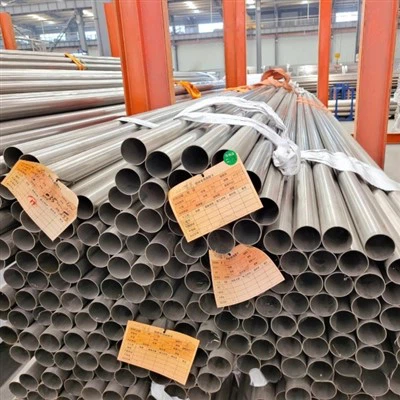
What Makes Super Duplex 2507 Different from Standard Stainless Steels?
In chloride-bearing industrial environments, standard austenitic stainless steels such as 304 and 316 reach their performance limits quickly. Pitting, crevice corrosion, and chloride-induced stress corrosion cracking become serious risks, especially in offshore oil and gas, seawater desalination, and chemical processing. Super Duplex 2507 (UNS S32750) was developed to solve exactly these problems.
ASTM A789 UNS S32750 is a ferritic-austenitic stainless steel tube with approximately equal proportions of austenite and ferrite in its microstructure. This dual-phase structure delivers properties that neither phase could achieve alone: high mechanical strength from the ferrite phase, and excellent toughness and corrosion resistance from the austenite phase.
The alloy's high chromium (24–26%), molybdenum (3–5%), and nitrogen (0.24–0.32%) content produces a Pitting Resistance Equivalent Number (PREN) typically in the range of 41–43, calculated as PREN = %Cr + 3.3 × %Mo + 16 × %N. This PREN value is the key indicator of the alloy's ability to resist localized corrosion in chloride environments.


Corrosion Resistance: PREN, CPT, and CCT
The corrosion resistance of UNS S32750 is its most defining characteristic. Three key parameters determine its performance in chloride environments:
Pitting Resistance Equivalent Number (PREN): With a PREN exceeding 41, S32750 significantly outperforms 316L (PREN ~26) and standard duplex 2205 (PREN ~35).
Critical Pitting Temperature (CPT): In standardized ferric chloride testing per ASTM G48, the CPT of Super Duplex 2507 exceeds 80°C, compared with approximately 60°C for 2205. This 20°C margin is critical for heat exchangers and other equipment operating in warm seawater or chloride-bearing process streams.
Critical Crevice Temperature (CCT): The CCT of S32750 is also significantly higher than that of 2205, providing an additional safety margin in gasketed or flanged connections.
Beyond localized corrosion, S32750 exhibits excellent resistance to chloride-induced stress corrosion cracking, a critical property for offshore operations and acidic natural gas service. The alloy is also highly resistant to erosion corrosion, making it suitable for high-flow seawater systems and systems handling sand-containing media.
ASTM A789 vs ASTM A790: Choosing the Right Standard
Both ASTM A789 and ASTM A790 cover duplex stainless steel products, but they apply to different product forms:
| Standard | Product Form | Typical Use |
|---|---|---|
| ASTM A789 | Tubing | Heat exchangers, boiler tubes, instrumentation |
| ASTM A790 | Pipe | Line pipe, process piping, fluid transport |
ASTM A789 is specifically written for tubing used in heat exchangers and similar equipment, while ASTM A790 is designed for pipe used in corrosive fluid transport and general corrosive service. Both standards include seamless and welded forms and cover UNS S32750.
S32750 vs 2205 vs 6Mo: A Comparison for Material Selection
Engineers frequently compare Super Duplex 2507 with standard duplex 2205 and super-austenitic 6Mo grades. Each material has its place:
| Property | Duplex 2205 | Super Duplex 2507 | 6Mo (254 SMO) |
|---|---|---|---|
| PREN | ~35 | ~42 | ~43 |
| Yield Strength, min | 450 MPa | 550 MPa | 300 MPa |
| Tensile Strength, min | 655 MPa | 800 MPa | 650 MPa |
| SCC Resistance | Excellent | Excellent | Excellent |
| Cryogenic Service | Limited (−40°C) | Limited (−40°C) | Yes (−196°C) |
| Sigma Phase Risk | Yes (>315°C) | Yes (>315°C) | None |
| Relative Cost | 1.3x | 2x | 2.5x |
Welding and Fabrication Considerations
UNS S32750 has good weldability, but requires stricter controls than standard duplex 2205. The high chromium and molybdenum content makes the material more sensitive to intermetallic phase precipitation (sigma and chi phases) if heat input is excessive or interpass temperatures are too high.
Key welding parameters for Super Duplex 2507 include:
Heat Input: Controlled to 0.2–1.5 kJ/mm to prevent sigma phase formation
Shielding Gas: Nitrogen-enriched shielding gas (N₂ + Ar) to maintain the austenite-ferrite balance
Interpass Temperature: Should not exceed 150°C
Solution Annealing: 1040–1120°C followed by rapid water quenching to bypass the sigma phase formation range
Qualification: NORSOK M-650 or ISO 17782 qualification is often required for offshore and subsea projects
Heat Treatment and Microstructure Control
Proper heat treatment is essential to achieve the optimal balance of austenite and ferrite phases in UNS S32750. The alloy should be solution annealed at 1025–1125°C followed by rapid quenching in water or by other means.
The balanced chemistry of 2507 results in a microstructure containing approximately equal amounts of ferrite and austenite after annealing. A ferrite content exceeding 70% decreases toughness and pitting resistance, while a content below 25% decreases SCC resistance. Micrographic examination per ASTM E562 is often specified to certify phase balance and freedom from intermetallic phases.
Applications: Where Super Duplex 2507 Excels
UNS S32750 tubing is specified for a wide range of aggressive environments:
Seawater Cooling: Heat exchanger tubing in chemical plants, refineries, and process industries using seawater or chlorinated seawater as coolant.
Desalination: Pressure vessels for reverse osmosis units, tube and pipe for seawater transport, and heat exchanger tubing on the concentrated brine side of the process.
Oil and Gas: Subsea umbilicals, flowlines, offshore platform topside piping, and sour service applications where the material is listed in NACE MR0175/ISO 15156.
Geothermal Wells: Heat exchangers and tubing for production in systems exposed to geothermal or high-salinity brines.
Pulp and Paper: Material for chloride-containing bleaching environments.
Flue Gas Desulfurization: Reheater tubes and scrubber piping in desulfurization units.
Quality Assurance and Testing
Every ASTM A789 UNS S32750 tube should undergo rigorous testing to ensure compliance with the specification and fitness for service:
| Test | Requirement |
|---|---|
| Chemical Analysis | Spectrochemical analysis per heat |
| Tensile Test | One per lot |
| Flattening Test | Required for welded tube |
| Hardness Test | Required |
| Hydrostatic Test | At pressure per the standard |
| NDT | Eddy Current or Ultrasonic Testing |
| Corrosion Test | ASTM A923 (Method A, B, or C) |
| Micrographic Examination | ASTM E562 for phase balance |
Summary: Why Specifying ASTM A789 UNS S32750 Pays Off
For engineers and procurement teams working on projects in chloride-bearing environments, ASTM A789 UNS S32750 Super Duplex 2507 tubing offers a combination of properties that few other materials can match: PREN exceeding 41, yield strength of 550 MPa, CPT exceeding 80°C, and excellent resistance to stress corrosion cracking. While the initial material cost is higher than 316L or 2205, the ability to reduce wall thickness, extend service life, and eliminate unplanned maintenance in critical offshore and desalination assets makes 2507 a strategic choice for minimizing lifecycle costs.