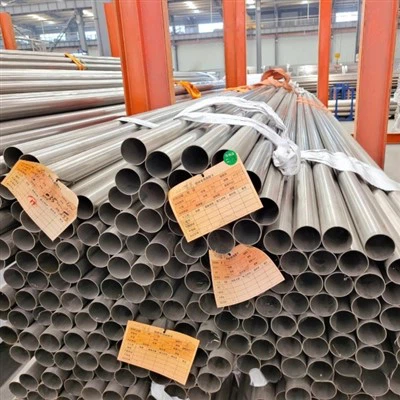
In refineries, seawater desalination plants, power stations and offshore installations, heat exchanger tube bundles sit at the intersection of two punishing demands: prolonged exposure to chloride-bearing media and continuous thermal cycling. Austenitic stainless steels such as 316L offer good toughness but are vulnerable to chloride stress corrosion; ferritic grades are strong but lack ductility. ASTM A789 Duplex Steel 2205 tubing resolves this trade-off. With a minimum yield strength roughly twice that of 316L, it permits thinner-wall designs that improve heat transfer, while its dual-phase microstructure delivers chloride resistance far beyond conventional austenitic grades. For engineering teams that evaluate materials on total life-cycle cost rather than purchase price alone, this combination explains why 2205 continues to gain ground in demanding thermal-duty service.

1. Understanding ASTM A789 Duplex Steel 2205 Tubing
1.1 The Dual-Phase Microstructure: More Than the Sum of Its Parts
The defining feature of Duplex 2205 is a roughly 50/50 balance of ferrite and austenite, and each phase compensates for the other's weaknesses:
|
Phase |
Contribution |
|
Ferrite |
High yield strength, inherent resistance to chloride stress corrosion cracking (SCC) |
|
Austenite |
Toughness, weldability and forming characteristics |
On its own, neither phase would be adequate for severe duty. Together they give the alloy the strength and SCC immunity of ferritic steels combined with the ductility and fabrication behavior of austenitic steels - a profile ideally suited to heat-transfer equipment operating in chloride-rich environments such as desalination plants, chemical processing units and offshore platforms.
1.2 Chemical Composition and Mechanical Properties
The alloy design of 2205 typically includes about 22% chromium, 5–6% nickel, 3% molybdenum and 0.14–0.20% nitrogen. Although nitrogen is added in the smallest quantity, it plays a decisive role: it stabilizes the austenite, preserves phase balance after welding and measurably improves pitting resistance. Working together, these elements produce a Pitting Resistance Equivalent Number (PREN) of ≥34, well above that of standard 316L.
Mechanically, ASTM A789 requires a minimum tensile strength of 655 MPa (95 ksi) and a minimum yield strength of 450 MPa (65 ksi) - margins that comfortably absorb the temperature and pressure fluctuations typical of heat exchanger service.
|
Property |
Duplex 2205 (S32205) |
Reference: 316L |
|
Cr / Ni / Mo / N |
~22% / 5–6% / ~3% / 0.14–0.20% |
~16–18% / 10–14% / 2–3% / trace |
|
PREN |
≥34 |
~24–26 |
|
Tensile strength (min.) |
655 MPa |
~485 MPa |
|
Yield strength (min.) |
450 MPa |
~170 MPa |
|
Thermal conductivity (RT, approx.) |
≈19 W/(m·K) |
≈16 W/(m·K) |
1.3 Manufacturing Standards and Quality Assurance
ASTM A789 imposes mandatory requirements on chemistry, mechanical properties, hydrostatic testing and non-destructive examination for duplex stainless steel tubing. Heat treatment deserves particular attention during production: tubes must be solution annealed at 1040–1100°C followed by rapid cooling, which restores the balanced phase ratio and prevents precipitation of sigma and other deleterious intermetallic phases - constituents that would otherwise erode both corrosion resistance and toughness.
On delivery, the Mill Test Report (MTR) should be checked line by line against ASTM A789 for chemistry, mechanical properties and dimensional tolerances, with heat numbers traceable to production records. For buyers, this document is the first line of defense against misrepresented material.
2. Why ASTM A789 2205 Tubing Extends Heat Exchanger Durability
2.1 Attacking the Typical Failure Modes
Heat exchangers rarely fail suddenly; they degrade. Corrosive process fluids thin the tube walls, start-stop operation imposes cyclic thermal stress, and chloride attack initiates pitting and crevice corrosion - a combination that shortens bundle life and drives up maintenance frequency. Against this backdrop, 2205 offers a "corrosion resistance + mechanical strength" package that conventional austenitic steels cannot match, reducing the risk of premature degradation in hot, chloride-bearing service and cutting unplanned shutdowns, emergency repairs and lost production.
Specifically, 2205 counters the three dominant failure modes of heat exchanger tubing:
Pitting and crevice corrosion: elevated chromium and molybdenum form a stable, dense passive film that resists breakdown in aggressive media;
Stress corrosion cracking (SCC): in a balanced duplex structure the ferrite phase blocks crack propagation along austenitic boundaries - a lethal failure mechanism for austenitic steels in salt-containing systems;
Tube-to-tubesheet joint attack: the tube ends are a classic hotspot for localized corrosion, and 2205's stronger localized-corrosion resistance markedly delays failure at these joints.
2.2 Performance Gains in the Field
Field experience with shell-and-tube units converted from 316L to 2205 tube bundles indicates service-life extensions of roughly five years. Two factors drive this improvement: the material retains its structure and properties through rapid temperature swings, and it suppresses the localized corrosion that typically starts at tube-to-tubesheet joints. The advantage is especially visible in steam generation systems and batch-processing plants where temperature and pressure fluctuate frequently.
2.3 Operational Benefits You Can Quantify
Durability eventually shows up on the balance sheet. Over the full life of a heat exchanger, 2205 tubing contributes on three fronts:
Maintenance cost: fewer failures mean less repair labor and less production lost to shutdowns;
Asset cost: longer replacement intervals reduce capital tied up in spare bundles and backup equipment;
Energy cost: thermal conductivity higher than common austenitic grades, combined with the thinner walls its strength allows, improves heat transfer - a tangible saving for temperature-critical processes.
For companies that make decisions on cost of ownership rather than first cost, this is the core business case for 2205.


3. How 2205 Compares with Alternative Heat Exchanger Tubing
3.1 Versus 316/316L Austenitic Stainless Steel
Strength: with roughly twice the yield strength of 316L, 2205 allows thinner walls at the same pressure rating - less weight, and significant savings on large-diameter tubing;
Corrosion: under identical chloride exposure, the critical pitting temperature (CPT) of 2205 typically runs 20–30°C higher than 316L, keeping it stable in evaporators, chemical media and seawater cooling circuits where 316L deteriorates quickly;
Price stability: 2205 contains about half the nickel of 316L, making it less exposed to nickel-price volatility and easier to budget for;
Compact equipment: higher strength allows pressure equipment designs with smaller footprints, reducing installation space and support-structure cost.
3.2 Versus Super Duplex Grades
Super duplex alloys such as UNS S32750 (PREN above 40) offer superior localized-corrosion resistance in high-temperature, high-chloride and acidic environments - at a price. Their material cost is higher and their welding procedures more demanding. For standard heat exchanger duty, 2205 delivers a more balanced answer. The guiding principle is "sufficient with margin": evaluate the actual media temperature, chloride concentration, pressure and chemical exposure, and pay the super duplex premium only when service conditions genuinely exceed 2205's envelope. Over-specifying material is a cost with no return.
3.3 Versus Carbon Steel and Other Alternatives
Carbon steel tubing (e.g., ASTM A106) is cheap to buy but limited in corrosion capability, typically requiring protective coatings and generous corrosion allowances - followed by frequent replacement and a heavy maintenance burden. Over the long term, its total cost often exceeds that of duplex alternatives. Material selection must still follow the service: where media are mild, carbon steel remains economical. Where corrosion dominates the duty, 2205 is usually the most cost-effective upgrade path.
4. Procurement Guide: Sourcing Genuine 2205 Tubing
4.1 Critical Specifications and Certifications
Procurement teams should verify:
Dimensions: outside diameter, wall thickness and length must match the exchanger design, with tolerances per the applicable general requirements;
Chemistry: the MTR must comply with ASTM A789, with particular attention to nitrogen content - it directly governs post-weld phase balance and corrosion performance;
Traceability: heat numbers on the MTR must map back to specific production records;
Independent verification: material accompanied by a certificate from a recognized third-party inspection body carries materially higher credibility;
Quality systems: an ISO 9001-certified supplier manages quality systematically from raw material to finished tube.
4.2 Evaluating Supplier Capability
Technical support: a reliable producer helps select grade, dimensions and heat-treatment condition - not "whatever is on the shelf";
Capacity and inventory: manufacturers with annual output in the five-figure tonnage range typically hold stable stock and are less likely to slip delivery schedules on large projects;
Testing capability: the plant should be equipped for phase-balance verification (ASTM E562 point count), corrosion testing (ASTM G48 ferric chloride method) and non-destructive examination; suppliers offering 100% eddy-current or hydrostatic testing provide stronger assurance of soundness and pressure integrity.
4.3 Inventory, Lead Times and Custom Orders
Standard 2205 sizes are widely available from stock and ship quickly; non-standard dimensions, special lengths or specific heat-treatment conditions usually add several weeks of production lead time. Building that lead time into project schedules is the practical way to avoid delays. Flexible minimum order quantities (MOQ) suit prototyping and small projects, while volume pricing tiers meaningfully reduce unit cost on large orders.


5. Best Practices for 2205 Tubing in Heat Exchangers
5.1 Welding and Fabrication
Duplex performance depends on preserving phase balance after welding, so heat control is everything:
Heat input: keep it within a controlled window to prevent excess ferrite in the heat-affected zone (HAZ);
Filler metal: use matched duplex consumables (e.g., ER2209) to maintain phase ratio and mechanical properties across the joint;
Interpass temperature: generally below 150°C for multi-pass welding to limit undesirable phase transformations;
Post-weld heat treatment: not always required, but recommended when intermetallic precipitation is suspected or when the duty is highly acidic - re-solution annealing at 1040–1100°C with rapid water quench restores HAZ phase balance.
5.2 Storage, Handling and Installation
Store tubes separately from carbon steel and use dedicated lifting gear and workstations to prevent carbon-steel contamination, which seeds localized corrosion;
Fit protective end caps to keep bores clean and prevent transit damage;
During installation, avoid carbon-steel tools and rollers in direct contact with the tube surface, which can cause iron contamination of the passive film;
Restore passivation damaged during fabrication or erection with a nitric acid passivation treatment;
At tube-to-tubesheet joints, apply expansion or welding procedures that achieve leak-tightness without introducing excessive residual stress - residual tensile stress is one of the necessary conditions for SCC.
5.3 Maintenance and Inspection
Scheduled inspection: visual checks catch surface corrosion, fouling and mechanical damage early; eddy-current testing reveals subsurface flaws invisible to the eye and tracks wall thinning;
Microstructure surveillance: periodic re-checking of phase ratio confirms it remains within limits and that no harmful intermetallic phases have formed in service;
Chemical cleaning: removes corrosion nucleation sites and heat-transfer barriers, but the agent must be controlled - hot, high-concentration chloride or strong acid solutions damage the passive film. Follow the manufacturer's recommended chemistry and procedure.
Conclusion
ASTM A789 Duplex Steel 2205 tubing consolidates chloride corrosion resistance, roughly double the yield strength of 316L and a lower total cost of ownership into a single material. For heat exchangers, that translates into fewer shutdowns, longer replacement cycles and better thermal economics. Realizing this potential, however, depends on disciplined execution across the whole chain - sensible selection, correct welding, clean installation and systematic maintenance. For procurement and engineering teams prioritizing durability, reliability and life-cycle cost, ASTM A789 2205 is a practical, proven choice for demanding heat exchanger systems.
FAQ
Q1: Why choose 2205 over 316L for heat exchangers?
2205 resists stress corrosion cracking far better than 316L and offers nearly twice the yield strength, allowing thinner walls - better heat transfer with lower weight and cost. Its chloride pitting and crevice resistance are also superior, which is decisive in evaporators, chemical streams and seawater cooling systems where 316L fails early.
Q2: What is the maximum operating temperature of 2205 tubing?
Generally 315°C (600°F). Prolonged exposure around 475°C causes alpha-prime (α′) precipitation in the ferrite - the "475°C embrittlement" - which degrades toughness and corrosion resistance. Above this range, austenitic grades are the better fit, though most industrial heat exchangers operate comfortably within 2205's safe envelope.
Q3: What is the difference between S31803 and S32205?
Both are "2205," but S32205 carries tighter minimum limits on chromium, molybdenum and nitrogen, giving more consistent corrosion resistance - especially in aggressive chloride service. Most modern duplex tubing is dual-certified to both, yet for critical projects it is best practice to specify S32205 in the purchase specification to guarantee margin for long service life.