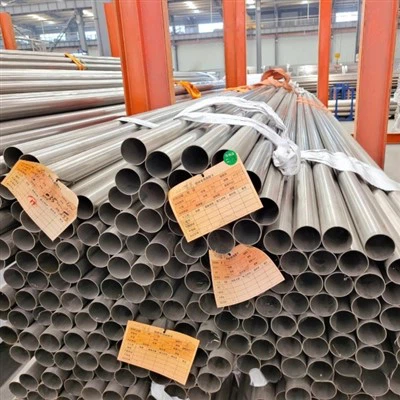
When a heat exchanger fails, the root cause almost always traces back to one word: corrosion. Chloride attack, stress corrosion cracking and pitting advance quietly inside the equipment until maintenance costs spiral and unplanned downtime becomes unavoidable. ASTM A790 S31803 stainless steel pipe was engineered to defeat exactly these failure modes. As a duplex grade combining austenitic and ferritic phases, it delivers mechanical strength roughly twice that of standard 316L while retaining outstanding resistance to localized corrosion. For procurement and engineering teams sourcing piping for demanding thermal and chemical duty, S31803 is a technically sound, cost-controllable choice backed by decades of field performance.

1. Understanding ASTM A790 S31803 Stainless Steel Pipe
1.1 Chemical Composition and Microstructure
The performance of S31803 begins with a carefully balanced chemistry: about 22% chromium, 5–6% nickel, 3% molybdenum and 0.14–0.20% nitrogen. Nitrogen is especially influential - it stabilizes the austenite phase and lifts the Pitting Resistance Equivalent Number (PREN), which for this grade typically exceeds 34. The resulting dual-phase structure, roughly half austenite and half ferrite, delivers a combination of properties neither phase could achieve alone:
|
Phase |
Contribution |
|
Ferrite |
High yield strength, disruption of SCC crack propagation |
|
Austenite |
Toughness, weldability and formability |
1.2 Mechanical Properties and Service Temperature
ASTM A790 specifies a minimum yield strength of 450 MPa (65 ksi) and a minimum tensile strength of 620 MPa (90 ksi) for S31803. That is far higher than 316L, whose minimum yield strength is typically only about 30 ksi. The surplus strength has an immediate commercial value: engineers can specify thinner walls, reducing material weight and the total installed cost of large projects. The temperature limit deserves equal attention - S31803 performs reliably up to about 300°C (572°F). Sustained exposure above that point triggers "475°C embrittlement" through precipitation of brittle secondary phases, so thermal design engineers should treat the ceiling as firm.
|
Property |
S31803 (ASTM A790) |
Reference: 316L |
|
Cr / Ni / Mo / N |
~22% / 5–6% / ~3% / 0.14–0.20% |
~16–18% / 10–14% / 2–3% / trace |
|
PREN |
typically >34 |
~24–26 |
|
Yield strength (min.) |
450 MPa (65 ksi) |
~170 MPa (~25–30 ksi) |
|
Tensile strength (min.) |
620 MPa (90 ksi) |
~485 MPa |
|
Recommended continuous service |
≤300°C (572°F) |
Higher, but chloride-limited |
2. Corrosion Resistance and Field Performance in Heat Exchanger Systems
In chemical processing, hydrogen production and fuel cell manufacturing, heat exchangers routinely face high-chloride cooling water, acidic condensates and sulfide-rich streams - precisely where austenitic grades such as 304 and 316L lose their corrosion resistance fastest. ASTM A790 S31803 stainless steel pipe provides three distinct protective characteristics that make it highly stable in these services:
Chloride stress corrosion cracking (SCC) resistance: the ferrite phase interrupts the continuous austenitic matrix that normally drives SCC, allowing the alloy to withstand chloride concentrations that would crack 316L tubes within months;
Superior pitting and crevice corrosion resistance: with a PREN above 34, S31803 resists the localized attack that initiates at tube-to-tubesheet joints and baffles - the recognized trouble spots of shell-and-tube exchangers;
Sulfide environment resistance: in oil and gas exchangers where H₂S and chlorides coexist, S31803 maintains structural integrity while standard austenitic grades crack under sulfide-induced stress.
These protective qualities translate directly into measurable operational results. Industry research consistently shows that duplex stainless steel exchanger tubes achieve service lives two to three times longer than equivalent 316L installations in chloride-bearing service, sharply reducing unplanned maintenance. That extended service life directly supports the long-cycle stability operators need in newer energy applications such as hydrogen electrolysis systems and fuel cell cooling circuits.


3. How S31803 Compares with Other Stainless Steel Grades
3.1 Versus S32205 and Super Duplex S32750
Many consider S32205 a "tightened-chemistry" refinement of ASTM A790 S31803, since it sets higher minimum levels of chromium, molybdenum and nitrogen, yielding a slightly higher PREN and marginally better corrosion resistance. Most ASTM A790 pipe on the market today is dual-certified to both grades, so the practical distinction for buyers is modest. Super duplex S32750, by contrast, is designed for harsher environments with a PREN above 42 - but its far heavier alloy content costs substantially more than typical heat exchanger service justifies. Where conditions are not severe, paying the super duplex premium is not economical.
3.2 Versus 316L and Carbon Steel
Versus 316L: S31803 offers roughly twice the yield strength of 316L and markedly better resistance to salt-induced corrosion. Although it costs more per unit weight, its superior strength permits thinner wall specifications, cutting overall pipe weight and fabrication cost;
Versus carbon steel: S31803 requires far less frequent coating and inspection, delivering a lower life-cycle cost that procurement teams can model during capital planning - an advantage that stands out wherever aqueous chlorides, acids or humid industrial atmospheres are present.
4. Procurement Considerations for ASTM A790 S31803 Pipe
4.1 Supplier Qualification and Quality Verification
Finding a capable S31803 supplier takes more than browsing a catalog. Procurement teams should confirm that prospective suppliers provide:
Traceable material certification: current Mill Test Reports (MTRs) traceable to reputable steel sources;
Documented inspection procedures: covering dimensional tolerances, hydrostatic testing and non-destructive examination;
Certified quality systems: alignment with ISO 9001 or an equivalent standard;
Third-party inspection access: recommended for large orders, with access during production.
4.2 Factors That Drive Pricing
Clarify the pricing drivers up front: the minimum order quantity (MOQ) needed to unlock tiered pricing; lead times for welded versus seamless configurations; surface finish requirements; and custom cut lengths or end preparations. Suppliers offering full professional support - including welding procedure assistance, material certification paperwork and logistics planning - add substantial value beyond the pipe itself.
5. Maximizing the Value of ASTM A790 S31803 Pipe in Your Projects
5.1 Welding and Installation
Welding is the first step in realizing S31803's performance. It requires controlled heat input and filler metals that are typically over-alloyed with 7–9% nickel to preserve phase balance in the heat-affected zone. Post-weld heat treatment is usually unnecessary; where a full anneal is required, it must be followed by rapid cooling to prevent sigma phase formation, which would erode corrosion resistance.
5.2 Maintenance and Long-Term Performance
The following practices safeguard long-term performance:
Scheduled inspection: periodic visual and eddy-current examination of tube bundles;
Prompt removal of iron contamination: prevents under-deposit corrosion from taking hold;
Fluid chemistry monitoring: keeps operating conditions inside the grade's qualified envelope.
S31803's versatility spans desalination, chemical processing, oil and gas, and emerging hydrogen infrastructure, so investment in correct installation and care pays back across the entire project life cycle.


Conclusion
For heat exchangers in harsh industrial settings, ASTM A790 S31803 stainless steel pipe is one of the most technically balanced materials available. Its duplex microstructure delivers mechanical strength and corrosion resistance that austenitic grades cannot match at the same wall thickness. For procurement managers in the new energy, chemical, automotive and aerospace industries, this grade is a dependable route to lower life-cycle costs and longer system life. Realizing that material advantage depends on selecting a supplier with verified certifications, clear quality documentation and responsive technical support.
FAQ
Q1: What is the difference between S31803 and S32205?
S32205 is a tightened-chemistry form of ASTM A790 S31803 with higher minimum levels of chromium, molybdenum and nitrogen, giving it a slightly higher PREN and marginally better corrosion resistance. Most pipe on the market today is dual-certified, meeting both standards.
Q2: Can S31803 duplex pipe be welded on site?
Yes, provided the right controls are in place. To preserve austenite–ferrite phase balance in the weld zone, welders should use nickel-alloyed low-hydrogen filler metals and keep heat input within the permitted range.
Q3: What is the maximum recommended service temperature?
S31803 should only be used continuously below 300°C (572°F). Long-term exposure above this level causes weakening through secondary phase precipitation.
Q4: How does S31803 compare to 316L on total cost?
Although S31803 costs more per unit weight, its higher yield strength permits thinner wall specifications. Thanks to lower weight and longer service life, the installed system typically costs less than a 316L equivalent over the project life cycle.
Q5: Does S31803 require post-weld heat treatment?
Generally no. If a solution anneal is required, it must be followed by rapid quenching to prevent formation of the sigma phase, which reduces toughness and corrosion resistance.