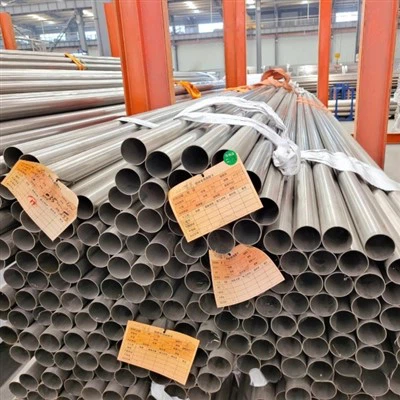
ASTM A790 UNS S32750, commonly known as Super Duplex 2507, is a high-performance ferritic-austenitic stainless steel engineered for the most demanding industrial environments. This super duplex grade combines exceptional corrosion resistance with very high mechanical strength, making it a preferred material for oil and gas, chemical processing, marine, and desalination applications. The alloy's unique dual-phase microstructure - approximately equal proportions of austenite and ferrite - delivers properties that neither phase could achieve alone.
This article provides a comprehensive technical overview of ASTM A790 UNS S32750 pipe, covering its chemical composition, mechanical properties, corrosion resistance, manufacturing standards, testing requirements, and typical applications.


What Is ASTM A790?
ASTM A790 is the American Society for Testing and Materials' standard specification for seamless and welded ferritic/austenitic (duplex) stainless steel pipe. It defines the composition and mechanical property requirements for seamless and straight-seam welded pipe, and also covers heat treatment, manufacturing process, sampling and testing, and product marking. The standard covers both standard duplex grades (such as S31803 and S32205) and super duplex grades (such as S32750 and S32760), making it the primary pipe specification for duplex stainless steel in the oil and gas, chemical, and marine industries.
All ASTM A790 pipes must be solution-annealed and quenched to achieve the target austenite-ferrite balance, typically 40-60% ferrite. For S32750, solution annealing at a minimum of 1025°C is required, followed by water quenching or rapid cooling by other means.
Chemical Composition of UNS S32750
| Element | Composition Range (%) |
|---|---|
| Carbon (C), max | 0.030 |
| Manganese (Mn), max | 1.20 |
| Phosphorus (P), max | 0.035 |
| Sulfur (S), max | 0.020 |
| Silicon (Si), max | 0.80 |
| Chromium (Cr) | 24.0 – 26.0 |
| Nickel (Ni) | 6.0 – 8.0 |
| Molybdenum (Mo) | 3.0 – 5.0 |
| Nitrogen (N) | 0.24 – 0.32 |
| Copper (Cu), max | 0.50 |
Mechanical Properties
| Property | Requirement |
|---|---|
| Tensile Strength, min | 116 ksi (800 MPa) |
| Yield Strength (0.2% offset), min | 80 ksi (550 MPa) |
| Elongation, min | 15% |
| Hardness, max (HBW) | 300 |
| Hardness, max (HRC) | 32 |
Corrosion Resistance
The corrosion resistance of UNS S32750 is its most defining characteristic. With a PREN of approximately 42, this super duplex grade offers exceptional performance in aggressive environments:
Pitting and Crevice Corrosion: In standardized ferric chloride testing per ASTM G48, 2205 typically resists pitting up to 35°C, while 2507 resists pitting up to 65°C. This 30°C margin determines which environments each grade can handle safely.
Stress Corrosion Cracking (SCC): S32750 exhibits excellent resistance to chloride-induced stress corrosion cracking, a critical property for offshore operations, acidic natural gas, and seawater desalination applications.
General Corrosion: The alloy is highly resistant to corrosion by organic acids. In 10% formic acid and 50% acetic acid, the corrosion rate is less than 0.05 mm/year, whereas ASTM 316L exhibits a corrosion rate higher than 0.2 mm/year under the same conditions.
Critical Pitting Temperature: The CPT of S32750 in 6% FeCl₃ is approximately 65°C, compared to ~35°C for 2205 duplex.
Heat Treatment and Microstructure
Proper heat treatment is essential to achieve the optimal balance of austenite and ferrite phases in UNS S32750. The pipes shall be heat treated at 1025-1125°C (1880-2060°F) and quenched by rapid cooling in water or by other means.
Research has shown that when the solution treatment temperature is 1050°C, the α/γ ratio approaches 1:1, yielding excellent overall properties. At temperatures below 1000°C, the σ phase (sigma phase) exists at α/γ grain boundaries and in ferrite grains, which severely degrades toughness and corrosion resistance. At temperatures above 1050°C, Cr₂N precipitates in ferrite and gradually grows and coarsens, also reducing performance.
The balanced chemical composition of 2507 results in a microstructure containing approximately equal amounts of ferrite and austenite after annealing at about 1050-1125°C. A ferrite content exceeding 70% decreases toughness and pitting resistance, while a content below 25% decreases SCC resistance.
Manufacturing and Testing Requirements
| Test | Requirement |
|---|---|
| Tensile Test | One per lot (transverse or longitudinal) |
| Flattening Test | Required for welded pipe |
| Hardness Test | Required |
| Hydrostatic Test | At pressure per formula in the standard (may be replaced by NDE) |
| NDT | Eddy Current or Ultrasonic Testing (UT) for welded seam |
| Corrosion Test | ASTM A923 (Method A, B, or C) |
Applications of ASTM A790 UNS S32750
The high strength and corrosion resistance of UNS S32750 make it suitable for a wide range of harsh environments, including chloride and sulphide service:
Oil and Gas: Offshore topside and subsea piping, deepwater risers, sour service applications, oil and gas exploration and offshore rigs
Marine Environments: Seawater desalination, marine engineering, shipbuilding
Chemical Processing: Chemical process plant, chemical processing, transport and storage, pollution control equipment
Pulp and Paper: Pulp and paper manufacturing
Other Industries: Heat exchangers, water treatment equipment, food processing, pharmaceutical industry
The alloy is especially crucial for resisting pitting, crevice corrosion, and stress corrosion cracking caused by chlorides in offshore operations, acidic natural gas, and seawater desalination applications.
Comparison: 2205 vs 2507
| Property | 2205 (S32205) | 2507 (S32750) |
|---|---|---|
| Classification | Standard duplex | Super duplex |
| Chromium | 22.0-23.0% | 24.0-26.0% |
| Nickel | 4.5-6.5% | 6.0-8.0% |
| Molybdenum | 3.0-3.5% | 3.0-5.0% |
| Nitrogen | 0.14-0.20% | 0.24-0.32% |
| PREN (typical) | 34-36 | 42-43 |
| Yield Strength, min | 450 MPa | 550 MPa |
| Tensile Strength, min | 620 MPa | 795 MPa |
| CPT in 6% FeCl₃ | ~35°C | ~65°C |
| Relative Cost | Baseline | 30-50% premium |
Frequently Asked Questions
What is the difference between ASTM A790 and ASTM A789?
ASTM A790 covers seamless and welded ferritic/austenitic (duplex) stainless steel pipe for general corrosive service, while ASTM A789 covers welded and seamless ferritic/austenitic stainless steel heat exchanger tubes. Both specifications include UNS S32750.
What is the maximum service temperature for UNS S32750?
The maximum service temperature is generally recommended as 315°C (600°F). However, VdTÜV standard recommends a maximum service temperature of 250°C for 2507.
Can UNS S32750 be welded?
Yes, UNS S32750 has good weldability. However, welding requires controlled heat input (typically 0.5-2.5 kJ/mm) and nitrogen-enriched shielding gas (N₂ + Ar) to maintain proper austenite-ferrite balance. Grade 2507, with its higher alloy content, is more sensitive to intermetallic precipitation if heat input is excessive or interpass temperatures exceed 150°C. Welding procedure qualification for 2507 requires stricter controls and more extensive testing.
What are the equivalent grades for UNS S32750?
UNS: S32750
EN Number: 1.4410
EN Name: X 2 CrNiMoN 25-7-4
SS: 2328
Common Name: Super Duplex 2507
Forging grade: ASTM A182 F53
Conclusion
ASTM A790 UNS S32750 Super Duplex stainless steel pipe represents the highest tier of duplex stainless steel technology. Its unique combination of high chromium, molybdenum, and nitrogen content delivers a PREN of approximately 42, providing exceptional resistance to pitting, crevice corrosion, and stress corrosion cracking in chloride-bearing environments. With a minimum yield strength of 550 MPa and tensile strength of 800 MPa, S32750 offers significant weight savings through thinner wall sections at the same design pressure. For demanding applications in oil and gas, chemical processing, desalination, and marine engineering, ASTM A790 UNS S32750 is the material of choice for engineers who require uncompromising performance in the most aggressive environments.