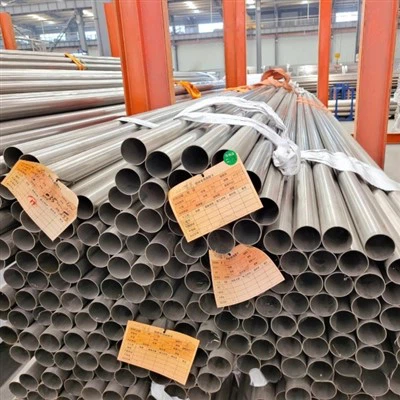
A seamless stainless steel pipe is exactly what its name implies - a tube with no longitudinal weld seam, produced by drilling a hole through a solid billet and then shaping that hollow shell into a finished pipe. That single difference in how it is made is why seamless pipe dominates the most demanding services in oil & gas, power generation, heat exchangers and aerospace. This article traces the route from solid bar to finished tube, explains the metallurgy behind its performance, and shows how buyers can verify they are getting genuine seamless product.
1. Where Seamless Pipe Fits in the Supply Chain
In the steel piping value chain, a seamless pipe sits between the raw material and the finished tubular component:
Solid Round Billet → Seamless Pipe → Finished Tubular Product (fittings, U-tubes, instrumentation lines)
Welded pipe starts from flat strip or plate that is rolled and joined along a longitudinal seam. Seamless pipe, by contrast, starts from a solid round bar and removes material to create the bore. The result is a more involved deformation path, tighter metallurgical control and - inevitably - a higher manufacturing cost. It is one of the most technically demanding segments of the pipe industry, and it is precisely this difficulty that earns it a place in systems where failure is not an option.
2. Turning a Solid Billet into a Hollow Tube
Producing a stainless seamless pipe involves two broad families of operations: a hot stage that creates the hollow, and a cold stage that delivers precision and a refined microstructure.
Hot Piercing - the Mannesmann Process
The round billet is first heated to roughly 1200°C to make it plastic. It is then fed between two conical rolls that are set at a cross angle and rotate at high speed. The combined compressive and shear action creates strong internal tensile stress at the centre of the bar, opening up a cavity that is then guided over a piercer mandrel. The output is a rough hollow shell - the wall thickness and diameter are not yet accurate, but the pipe is structurally born.
For stainless grades this hot shell still carries work hardening and a coarse grain structure, so it must be conditioned before finishing.
Cold Drawing and Cold Pilgering - Precision Finishing
After piercing, the hollow shell is brought to final size by cold working, which also restores the mechanical and corrosion properties through intermediate solution annealing:
| Method | How it works | What it delivers |
|---|---|---|
| Cold drawing | The tube is pulled through a tapered die (often over a mandrel) to reduce diameter and wall. | Good dimensional accuracy and surface finish; wall tolerance is slightly wider than pilgering. |
| Cold pilgering (cold rolling) | A reciprocating grooved die progressively rolls the tube against a tapered mandrel. | Tightest tolerances (down to about ±0.05 mm), very dense microstructure, enhanced mechanical performance. |

3. Why High-Pressure Service Demands Seamless
In a thick-walled cylinder under internal pressure, stress is not evenly shared. Using the classic Lamé equation, the hoop (circumferential) stress at radius r is:
σθ = [ Pi · ri² / (ro² − ri²) ] · [ 1 + (ro² / r²) ]
where Pi is internal pressure, ri the inner radius, ro the outer radius.
The key takeaway: the inner wall carries significantly higher stress than the outer wall. A weld seam is a zone of microstructural heterogeneity - different grain flow, possible inclusions, local hardness variation. Under high pressure that heterogeneity becomes a stress concentrator, and localized amplification can trigger crack initiation at the seam.
A seamless pipe is metallurgically isotropic and homogeneous around its circumference, so stress distributes uniformly and the burst-failure risk at the inner wall drops sharply. In oil & gas, nuclear, aerospace and defense systems with zero-failure tolerance, that advantage is not optional - it is a specification requirement.

4. What Drives the Cost of Seamless Pipe
Seamless pipe costs more than welded pipe of the same grade for structural reasons:
Material form premium - Seamless starts from round billets, which are typically more expensive than the flat strip used for welded pipe of the same alloy.
Material loss - Piercing discards the centre of the billet as scrap; cold rolling and drawing trim heads and tails. Typical yield: seamless 75–80% versus welded ~97%.
Energy and pickling - Each cold pass needs solution annealing and descaling (pickling/passivation for stainless), multiplying heat-treatment cycles, electricity and chemical costs.
Multiple operations - Piercing, several cold passes, annealing, straightening, testing and finishing all add steps a welded line largely skips.
5. How to Identify Fake "Seamless" Welded Pipe
In some markets welded pipe is ground and polished to hide the seam and sold as seamless. Two practical field checks help:
Wall-Thickness Eccentricity
Welded pipe originates from flat strip, so its wall is extremely uniform around the circumference.
True seamless pipe usually shows slight eccentricity because the mandrel offsets during piercing.
If four-point wall measurements around the circumference deviate by less than 0.01 mm, the pipe is very likely a disguised welded product.
Acid-Etch Metallographic Test
Cut a cross-section sample and etch it for roughly 10 minutes.
Welded pipe: a faint longitudinal line appears at the weld zone due to microstructural contrast.
True seamless pipe: uniform colour and structure all the way around - no seam line.
FAQ
Q: Is seamless stainless pipe always stronger than welded pipe?
A: Not in absolute strength - a well-made welded pipe of the same grade has similar base strength. Seamless wins on stress uniformity and the absence of a seam as a potential failure line, which matters most under high pressure and fatigue.
Q: Why does stainless seamless pipe need annealing between passes?
A: Cold working hardens stainless and can precipitate chromium carbides. Solution annealing dissolves them and restores both ductility and corrosion resistance - essential for the austenitic and duplex grades used in corrosive service.
Q: Can I tell seamless from welded by eye?
A: Not reliably on a polished surface. Use the wall-eccentricity check or, definitively, an acid-etch cross-section test.
Q: Which standards cover stainless seamless pipe?
A: Common ASTM specs include A312 (austenitic weldless pipe), A213 (boiler/superheater tubes), A269 (instrumentation/service tubes), A789/A790 (duplex and super duplex).